Why Integrative Mental Health Matters Today
Today more than one in five U.S. adults experiences a mental‑health disorder, a prevalence that has risen steadily over the past decade. Traditional care that targets only symptoms—often through medication or brief talk therapy—frequently leaves underlying drivers such as poor sleep, nutrition, stress, or social isolation unaddressed, resulting in high relapse rates and treatment resistance. In response, clinicians are turning to whole‑person models that blend evidence‑based psychotherapy with lifestyle medicine, nutrition counseling, mindfulness, movement, and community connection. This integrative approach honors the mind‑body‑spirit connection, personalizes interventions to each client’s biological, psychological, and social context, and has been shown to improve outcomes, reduce medication side‑effects, and foster lasting resilience. Patients feel more engaged when care aligns with their values and hope.
Foundations of Integrative Mental Health
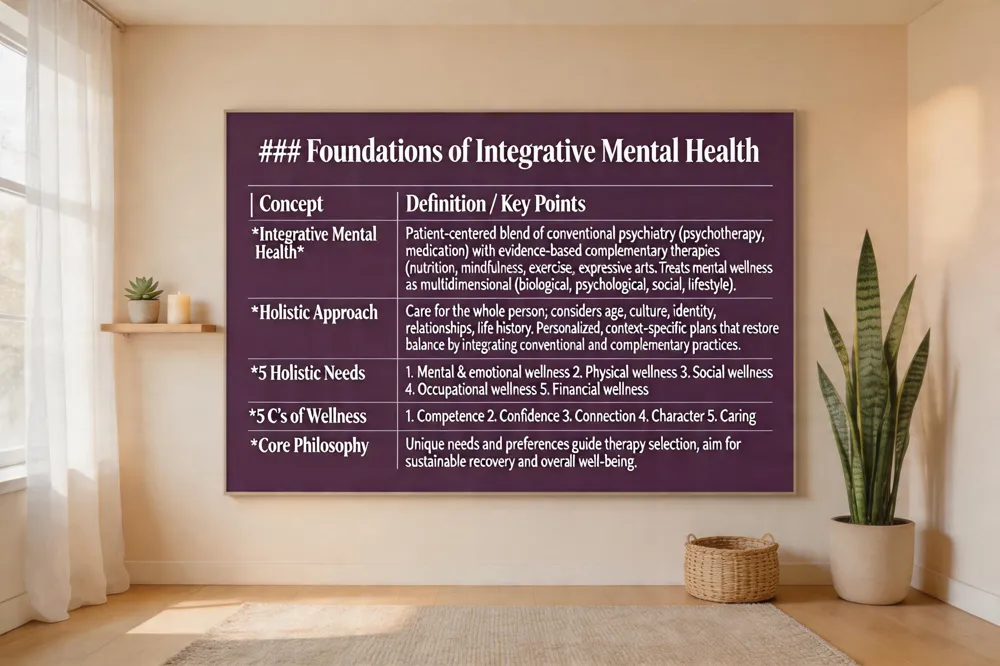
Foundations of Integrative Mental Health
| Concept | Definition / Key Points |
|---|---|
| Integrative Mental Health | Patient‑centered blend of conventional psychiatry (psychotherapy, medication) with evidence‑based complementary therapies (nutrition, mindfulness, exercise, expressive arts). Treats mental wellness as multidimensional (biological, psychological, social, lifestyle). |
| Holistic Approach | Care for the whole person; considers age, culture, identity, relationships, life history. Personalized, context‑specific plans that restore balance by integrating conventional and complementary practices. |
| 5 Holistic Needs | 1. Mental & emotional wellness 2. Physical wellness 3. Social wellness 4. Occupational wellness 5. Financial wellness |
| 5 C's of Wellness | 1. Competence 2. Confidence 3. Connection 4. Character 5. Caring |
| Core Philosophy | Unique needs and preferences guide therapy selection; aim for sustainable recovery and overall well‑being. |
 Integrative mental health meaning
Integrative mental health is a patient‑centered approach that blends conventional psychiatric care—such as psychotherapy and medication—with evidence‑based complementary therapies. It treats mental wellness as multidimensional, addressing biological, psychological, social, and lifestyle factors in a personalized plan. Modalities like nutrition counseling, mindfulness, exercise, and expressive arts are integrated to enhance standard treatments and promote overall well‑being. The philosophy emphasizes that each individual’s unique needs and preferences guide therapy selection, aiming for sustainable recovery.
What is the meaning of integrative mental health?
It is a holistic care model that addresses physical, emotional, mental, and spiritual needs rather than isolated symptoms. By combining psychotherapy, medication, mindfulness, nutrition, and creative arts, practitioners create personalized plans that honor the mind‑body connection while adhering to evidence‑based safety standards.
Holistic approach meaning
A holistic approach cares for the whole person, recognizing that age, culture, identity, relationships, and life history shape health. Treatment plans are personalized, context‑specific, and aim to restore balance by integrating conventional medicine with complementary practices.
What are the 5 holistic needs?
- Mental & emotional wellness – managing thoughts, feelings, stress.
- Physical wellness – activity, nutrition, sleep.
- Social wellness – supportive relationships and belonging.
- Occupational wellness – job satisfaction and work‑life balance.
- Financial wellness – resource management and security.
What are the 5 C's of wellness?
- Competence – feeling capable.
- Confidence – belief in abilities.
- Connection – healthy relationships.
- Character – acting with integrity.
- Caring – empathy toward self and others.
Therapeutic Modalities and Lifestyle Integration
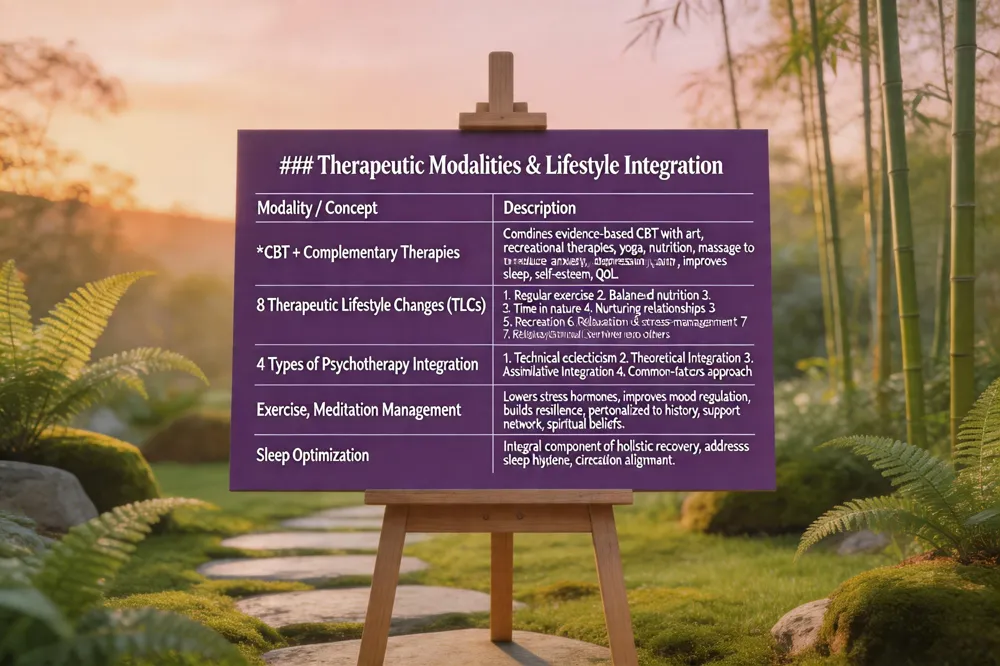
Therapeutic Modalities & Lifestyle Integration
| Modality / Concept | Description |
|---|---|
| CBT + Complementary Therapies | Combines evidence‑based CBT with art, recreational therapies, yoga, nutrition, massage to reduce anxiety, depression, pain; improves sleep, self‑esteem, QoL. |
| 8 Therapeutic Lifestyle Changes (TLCs) | 1. Regular exercise 2. Balanced nutrition 3. Time in nature 4. Nurturing relationships 5. Recreation 6. Relaxation & stress‑management 7. Religious/spiritual involvement 8. Service to others |
| 4 Types of Psychotherapy Integration | 1. Technical eclecticism 2. Theoretical integration 3. Assimilative integration 4. Common‑factors approach |
| Exercise, Meditation Management** | Lowers stress hormones, improves mood regulation, builds resilience; personalized to history, support network, spiritual beliefs. |
| Sleep Optimization | Integral component of holistic recovery; addresses sleep hygiene, circadian alignment. |
 Holistic care in mental health expands beyond isolated symptoms, integrating CBT, art and recreational therapies, yoga, nutrition, and massage to address stressors, improve emotional regulation, and promote physical well‑being. This goal‑oriented approach reduces anxiety, depression, and pain while enhancing sleep, self‑esteem, and quality of life.
Holistic approach to mental health recovery treats the whole person by pairing evidence‑based therapies with nutrition, exercise, mindfulness, and sleep optimization. Practices such as yoga or meditation lower stress hormones, improve mood regulation, and build resilience, while personalized plans honor each individual's history, support network, and spiritual beliefs.
What are the 8 Therapeutic Lifestyle Changes? The eight core TLCs are regular exercise, balanced nutrition, time in nature, nurturing relationships, recreation, relaxation and stress‑management, religious or spiritual involvement, and service to others.
What are the 4 types of psychotherapy integration? They are technical eclecticism, theoretical integration, assimilative integration, and the common‑factors approach, each offering a distinct strategy for combining therapeutic techniques.
Professional Landscape, Training and Certification
Professional Landscape, Training & Certification
| Role / Provider | Required Credentials | Certification (example) | Notable Clinics |
|---|---|---|---|
| Integrative Mental‑Health Clinician | Master's‑level degree + state licensure (LMHC, LCSW, psychologist, psychiatrist, NP) | Certified Integrative Mental Health Professional (CIMHP) – 18 hrs CE, 20 integrative sessions documentation | Manhattan Wellness, Manhattan Mental Health Counseling, Clarity Mental Health Counseling |
| Functional & Integrative Psychiatry Fellowship | Medical degree + psychiatry residency | Fellowship (Psychiatry Redefined) – focus on inflammation, microbiome, sleep, non‑pharma planning | |
| Integrative Psychiatry Institute (IPI) | Psychiatrist or advanced mental‑health clinician | Training in psychedelic‑assisted therapies (ketamine, etc.) | — |
| Insurance Acceptance | Varies by plan | Many accept Aetna, Cigna, UnitedHealthcare, Medicaid, Medicare; coverage for adjunctive modalities (nutrition, yoga, acupuncture) depends on plan | — |
 Integrative mental‑health providers are clinicians who blend evidence‑based psychotherapy with complementary modalities such as nutrition counseling, mindfulness, yoga, acupuncture, and lifestyle coaching. To practice in this space, most professionals hold a master’s‑level degree and a state license (psychologist, LMHC, LCSW, psychiatrist, or psychiatric nurse practitioner) and then pursue an integrative mental‑health certification. Programs such as the Certified Integrative Mental Health Professional (CIMHP) course from Evergreen Certifications or the Functional & Integrative Psychiatry Fellowship from Psychiatry Redefined require at least 18 hours of targeted continuing‑education, documentation of 20 clinical sessions using integrative strategies, and mastery of topics like inflammation, microbiome, sleep, and non‑pharmaceutical treatment planning. This credential validates a clinician’s ability to design personalized, whole‑person care plans and helps differentiate practices in a competitive wellness market.
Examples of clinics embracing this model include Manhattan Wellness (boutique therapy, group workshops, and same‑week virtual or in‑person sessions with glowing patient reviews), Manhattan Mental Health Counseling (integrative psychotherapy combining CBT, mindfulness, and body‑oriented techniques), and Clarity Mental Health Counseling (CBT, ACT, somatic and mindfulness). The Integrative Psychiatry Institute offers advanced training in psychedelic‑assisted therapies, expanding treatment options for refractory anxiety, depression, and PTSD.
Insurance considerations vary by provider, but many integrative practices accept major U.S. plans (Aetna, Cigna, UnitedHealthcare, Medicaid, Medicare) and can assist with claim submission. Patients should verify coverage for both conventional services (therapy, medication) and adjunctive modalities (nutrition, yoga, acupuncture) to maximize benefit and reduce out‑of‑pocket costs.
Evidence Base, Scholarly Insights and System Models
Evidence Base, Scholarly Insights & System Models
| Study / Author | Key Findings |
|---|---|
| Patterson, Miller & Hannapel (2025) | Nutrition, sleep, movement, mindfulness must accompany psychotherapy to address biopsychosocial roots of depression & anxiety. |
| Ribeiro et al. (2024) | Yoga & meditation enhance therapeutic gains, reduce medication reliance. |
| Shafran, Bennett & McKenzie‑Smith (2017) | Expressive arts improve outcomes alongside standard psychotherapies. |
| Integrative Collaborative‑Care Model | Team‑based (mental‑health clinicians, PCPs, dietitians, movement specialists) using shared EHR, case conferences, PHQ‑9 & GAD‑7 monitoring for real‑time progress. |
| Metabolic/Inflammatory Link | Mental disorders associated with metabolic, inflammatory, immune dysregulation; lifestyle medicine pillars (plant‑based diet, activity, sleep, stress management, substance avoidance, social connection) address these pathways. |
| Peer‑Support | Emotions Anonymous (EA) provides 12‑step fellowship for depression, anxiety, emotional challenges. |
 Holistic mental‑health scholarship repeatedly calls for whole‑person care. Patterson, Miller, and Hannapel (2025) argue that nutrition, sleep, movement, and mindfulness must accompany psychotherapy to address the biopsychosocial roots of depression and anxiety. Ribeiro et al. (2024) and Shafran, Bennett, and McKenzie‑Smith (2017) provide evidence that yoga, meditation, and expressive arts enhance therapeutic gains while lowering reliance on medication alone.
A need for this approach is underscored by data linking mental disorders to metabolic, inflammatory, and immune dysregulation. Integrating lifestyle medicine pillars—plant‑based nutrition, regular activity, adequate sleep, stress management, substance avoidance, and social connection—addresses both mind and body, improving resilience and long‑term remission.
An integrative collaborative‑care model brings mental‑health clinicians, primary‑care physicians, dietitians, and movement specialists together via shared electronic records and regular case conferences. This team‑based strategy tailors treatment plans to each person’s physical comorbidities and mental‑health goals, using tools such as the PHQ‑9, GAD‑7 and personalized wellness coaching to monitor progress in real time.
For peer‑support, Emotions Anonymous (EA) offers a 12‑step fellowship analogous to AA but focused on depression, anxiety, and other emotional challenges, providing a community‑based recovery pathway.
Future Directions, Personalized Care and Self‑Help Resources
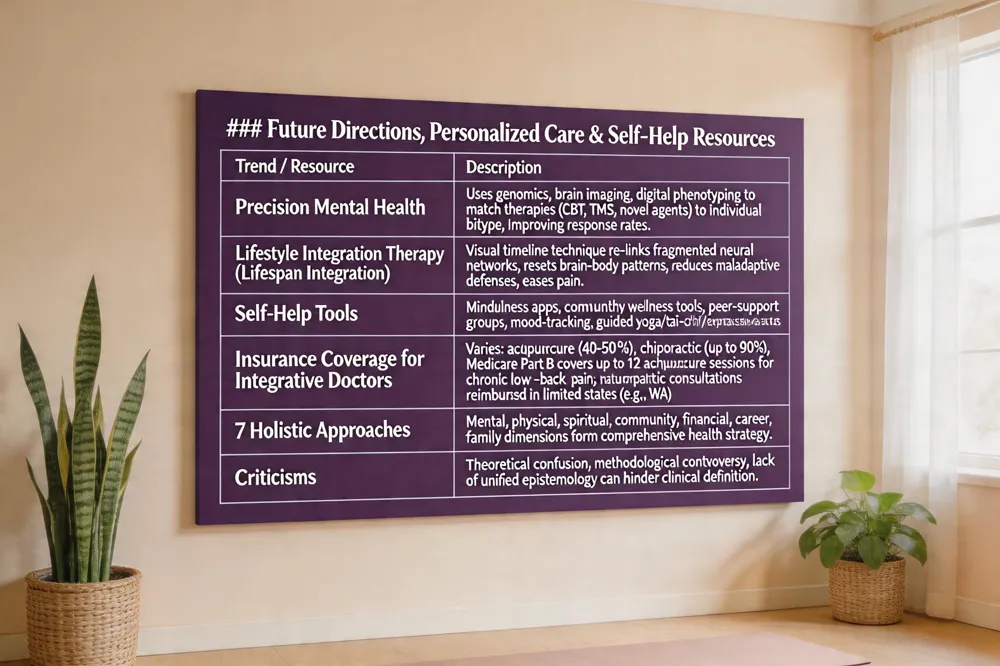
Future Directions, Personalized Care & Self‑Help Resources
| Trend / Resource | Description |
|---|---|
| Precision Mental Health | Uses genomics, brain imaging, digital phenotyping to match therapies (CBT, TMS, novel agents) to individual biotype, improving response rates. |
| Lifestyle Integration Therapy (Lifespan Integration) | Visual timeline technique re‑links fragmented neural networks, resets brain‑body patterns, reduces maladaptive defenses, eases pain. |
| Self‑Help Tools | Mindfulness apps, community wellness tools, peer‑support groups, mood‑tracking, guided yoga/tai‑chi/expressive arts to reinforce gains. |
| Insurance Coverage for Integrative Doctors | Varies: acupuncture (40‑50 %); chiropractic (up to 90 %); Medicare Part B covers up to 12 acupuncture sessions for chronic low‑back pain; naturopathic consultations reimbursed in limited states (e.g., WA). |
| 7 Holistic Approaches | Mental, physical, spiritual, community, financial, career, family dimensions form comprehensive health strategy. |
| Criticisms | Theoretical confusion, methodological controversy, lack of unified epistemology can hinder clinical definition. |
 The next wave of mental‑health care blends precision mental health with lifestyle‑based interventions, offering patients a truly personalized roadmap. Precision approaches combine genomics, brain imaging, and real‑time digital phenotyping to match therapies—whether CBT, TMS, or novel agents—to an individual’s biotype, dramatically improving response rates for depression and anxiety.
What is lifestyle integration therapy? Lifestyle integration therapy (often called Lifespan Integration) uses a gentle visual timeline to help clients re‑watch life “movies,” allowing fragmented neural networks to re‑link and the nervous system to recognize that time has passed. By resetting brain‑body patterns, it reduces maladaptive defenses, eases pain, and supports more adaptive responses to present stressors.
Self‑help groups, mindfulness apps, and community‑based wellness tools now complement formal treatment, providing peer support, mood‑tracking, and guided movement practices such as yoga, tai‑chi, and expressive arts therapy that reinforce therapeutic gains.
Does insurance cover integrative doctors? Coverage varies widely: many plans reimburse acupuncture (40‑50 % of visits) and chiropractic care (up to 90 %); Medicare Part B covers up to 12 acupuncture sessions for chronic low‑back pain. Naturopathic and broader integrative consultations are reimbursed in a few states (e.g., Washington) but often require referrals or are out‑of‑pocket elsewhere. Patients should verify benefits before scheduling.
What are the 7 holistic approaches? The seven elements—mental, physical, spiritual, community, financial, career, and family—form the foundation for a comprehensive, whole‑person health strategy.
Integrative Psychiatry Institute IPI trains clinicians in psychedelic‑assisted therapies, especially ketamine‑assisted psychotherapy, integrating conventional psychiatry with holistic modalities and providing mentorship, prescriber networks, and ethical frameworks for personalized care.
Criticisms of integrative psychotherapy Critics note theoretical confusion and methodological controversy, arguing that the model lacks a unified epistemology and can be difficult to define clinically.
What are the 5 C’s of wellness? Competence, Confidence, Connection, Character, and Caring—each promotes skillful coping, self‑belief, supportive relationships, integrity, and empathy toward self and others.
Moving Forward with Integrated, Holistic Care
Recent research shows that blending lifestyle medicine with behavioral health produces stronger, more durable outcomes than either approach alone. Clinical trials confirm that adding regular movement, plant‑based nutrition, sleep hygiene, and mindfulness to psychotherapy reduces depressive scores by up to 30 % and lowers relapse risk. By presenting patients with clear options—evidence‑based medication, talk therapy, yoga, nutrition counseling, or digital mood‑tracking tools—clinicians empower individuals to co‑design plans that fit their values, cultural context, and daily routines. Looking ahead, funding agencies should prioritize large‑scale, longitudinal studies that compare multimodal protocols, while insurers and policymakers expand coverage for integrative services such as acupuncture, art therapy, and personalized health‑coaching. Together, these steps will cement a patient‑centered, whole‑person model that is both scientifically sound and accessible. It also encourages clinicians to update skills through training.