Understanding the Integrative Pain Paradigm
Chronic pain is defined as pain that persists beyond the normal tissue‑healing period—generally longer than three to six months—and affects roughly 20 % of U.S. adults, often impairing daily function and quality of life. Modern pain science frames this experience within a biopsychosocial model, recognizing that biological factors (tissue injury, inflammation, nerve sensitization) intertwine with psychological elements (catastrophizing, anxiety, depression) and social determinants (housing stability, support networks, socioeconomic stress). Because pain is generated and modulated by the brain, addressing only the physical tissue leaves the broader network untouched. Consequently, integrative pain care prioritizes medication reduction, especially opioid reliance, by pairing conventional treatments with evidence‑based complementary modalities such as acupuncture, massage, yoga, mindfulness‑based stress reduction, and targeted exercise. These approaches collectively diminish pain intensity, improve function, and empower patients to reclaim agency over their health while minimizing the risks of long‑term pharmacologic therapy.
Non‑Pharmacological Treatment Options
| Modality | Description | Benefits | Typical Frequency / Duration |
|---|---|---|---|
| Patient Education & Self‑Management | Structured programs teaching pain biology, goal setting, sleep hygiene, anti‑inflammatory nutrition | Empowers patients, improves coping, reduces pain perception | Weekly sessions 4‑6 weeks, ongoing self‑practice |
| Therapeutic Exercise & Yoga | Aerobic conditioning, strength training, gentle yoga sequences | Improves mobility, releases endorphins, lowers pain scores | 2‑3 times/week, 30‑60 min per session |
| Manual Therapies (Massage, Osteopathic/Spinal Manipulation) | Hands‑on techniques targeting soft‑tissue tension and joint mobility | Short‑term pain relief, increased range of motion | 1‑2 times/week, 30‑45 min |
| Acupuncture | Insertion of fine needles at specific points | Modulates neural pathways, reduces opioid cravings | 6‑12 sessions, 1 hour each |
| TENS (Transcutaneous Electrical Nerve Stimulation) | Low‑frequency electrical stimulation of skin | Blocks pain signals, non‑pharmacologic analgesia | 20‑30 min daily as needed |
| Mind‑Body Practices (Mindfulness Meditation, Guided Imagery, Hypnosis, VR Distraction) | Cognitive techniques to alter pain perception | Decreases catastrophizing, enhances relaxation | 10‑20 min daily or weekly group sessions |
| Comfort Strategies (Heat/Cold, Positioning, Supportive Counseling) | Physical and psychosocial interventions for comfort | Reduces muscle spasm, improves functional comfort | As needed, individualized |
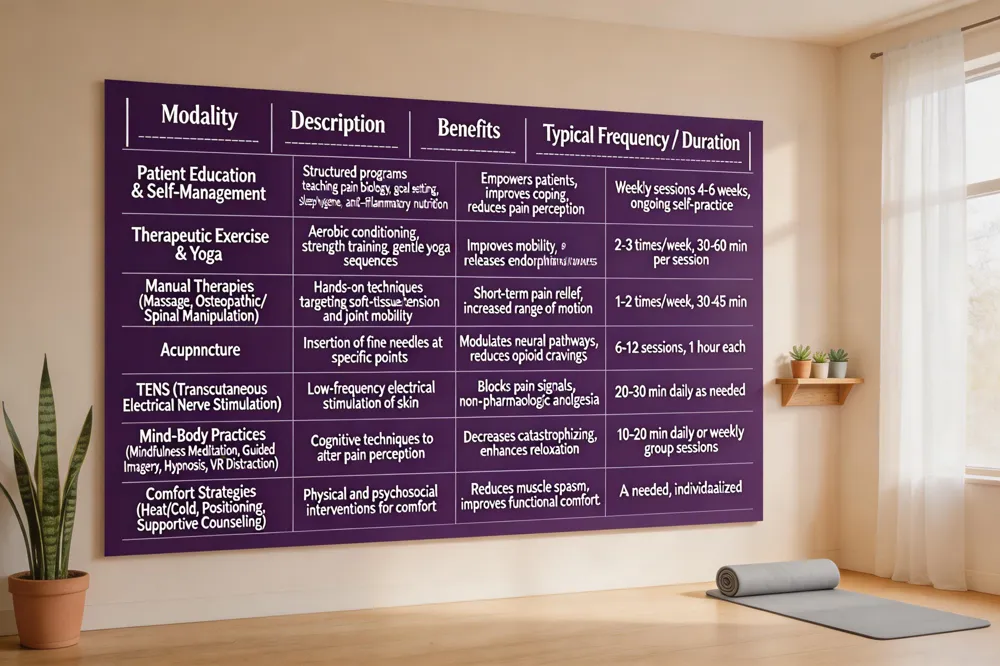 Integrative pain care begins with education and self‑management, empowering patients to understand the biology of pain, set realistic goals, and adopt healthy habits such as sleep hygiene and anti‑inflammatory nutrition. Exercise and yoga are core components; structured aerobic conditioning, strength training, and gentle yoga sequences improve mobility, release endorphins, and lower pain scores within weeks. Manual therapies—massage, osteopathic/spinal manipulation, acupuncture, and TENS—target soft‑tissue tension and neural pathways, providing short‑term relief without serious adverse events. Mind‑body practices, including mindfulness meditation, guided imagery, hypnosis, and virtual‑reality distraction, modulate central pain processing and reduce catastrophizing. Comfort strategies such as heat or cold application, optimal positioning, and supportive counseling round out the regimen, enhancing relaxation and functional comfort.
Non pharmacological treatment examples: patient education and self‑management programs; therapeutic exercise and yoga; manual and electrophysical therapies like massage, acupuncture, TENS; mind‑body techniques such as meditation, mindfulness, guided imagery, hypnosis, VR distraction; comfort‑oriented measures including heat/cold, positioning, and counseling.
Cleveland Clinic’s Holistic Pain Management Program
| Service | Provider Type | Key Features | Coverage / Access |
|---|---|---|---|
| Initial Evaluation | Integrative‑Medicine Physician | Comprehensive assessment, personalized plan | Covered by most major insurers |
| Acupuncture | Certified Acupuncturist | Targeted for musculoskeletal pain | Often covered; co‑pay varies |
| Chiropractic Adjustments | Licensed Chiropractor | Spine and joint alignment | Covered under many plans |
| Nutrition Counseling | Registered Dietitian | Anti‑inflammatory diet, weight management | Usually covered |
| Health Coaching | Certified Health Coach | Lifestyle modification, goal tracking | Covered or low‑cost |
| Mind‑Body Therapy (Guided Imagery, Mindfulness) | Trained Therapist | Virtual sessions, stress reduction | Covered or reimbursable |
| Virtual Visits | Telehealth Platform | Remote follow‑up, flexibility | Covered under telehealth benefits |
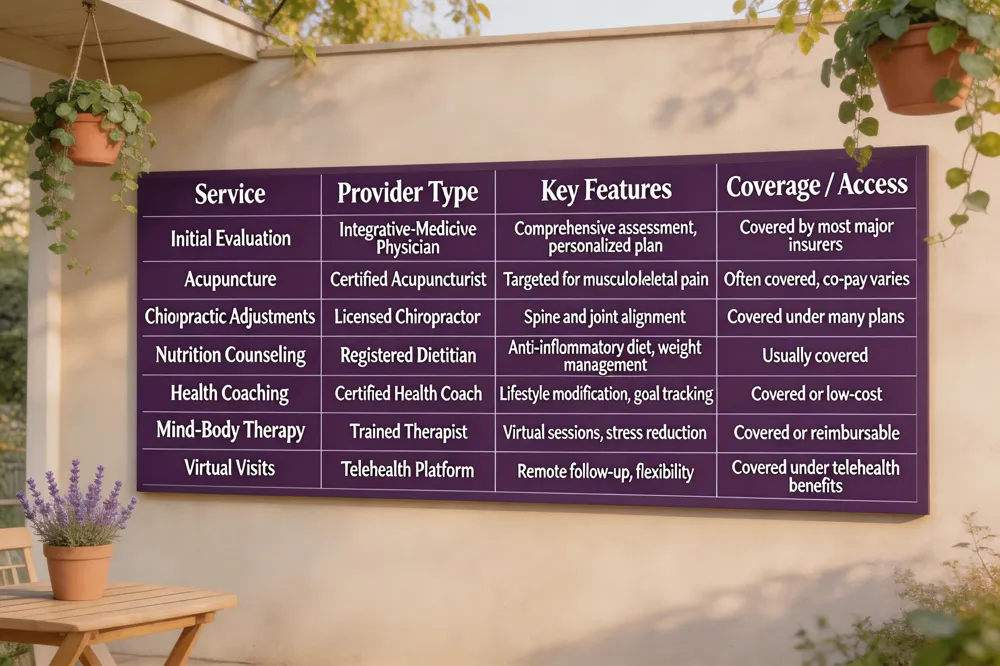 Cleveland Clinic’s Holistic Pain Management Program delivers multidisciplinary, patient‑centered care that blends conventional medicine with evidence‑based complementary therapies. After an initial evaluation by an integrative‑medicine physician, patients are placed in a coordinated team that may include acupuncture specialists, chiropractors, nutritionists, health‑coaches, and mind‑body therapists. The program offers acupuncture and chiropractic adjustments for musculoskeletal pain, while nutrition counseling and health‑coaching address inflammation, weight management, and lifestyle factors that influence pain. Virtual visits expand access, allowing patients to receive guided imagery, mindfulness training, and follow‑up appointments remotely. Most major insurance plans cover the core services, reducing financial barriers and supporting long‑term adherence. By integrating physical, psychological, and social dimensions of chronic pain, the program aims to lower opioid reliance, improve functional outcomes, and enhance overall quality of life.
Preventing Drug Dependency Through Integrated Care
| Step | Intervention | Goal | Evidence |
|---|---|---|---|
| 1. Screening & Self‑Assessment | Validated questionnaires, self‑tools | Early identification of dependence risk | IASP definition, CDC guidelines |
| 2. Medically Supervised Detox | Safe tapering + acupuncture, yoga, MBSR | Reduce cravings, support withdrawal | NIDA, NCCIH studies |
| 3. Trigger Identification | Structured interviews, validated tools | Pinpoint stressors, environments | Collaborative care models improve outcomes |
| 4. Support Network Building | Family involvement, peer groups, care‑coordinator | Enhance adherence, reduce relapse | Peer support reduces medication reliance |
| 5. Long‑Term Coping Skills | Regular exercise, anti‑inflammatory nutrition, sleep hygiene, mind‑body practices | Sustain wellness, prevent re‑use | Multiple studies show reduced opioid use |
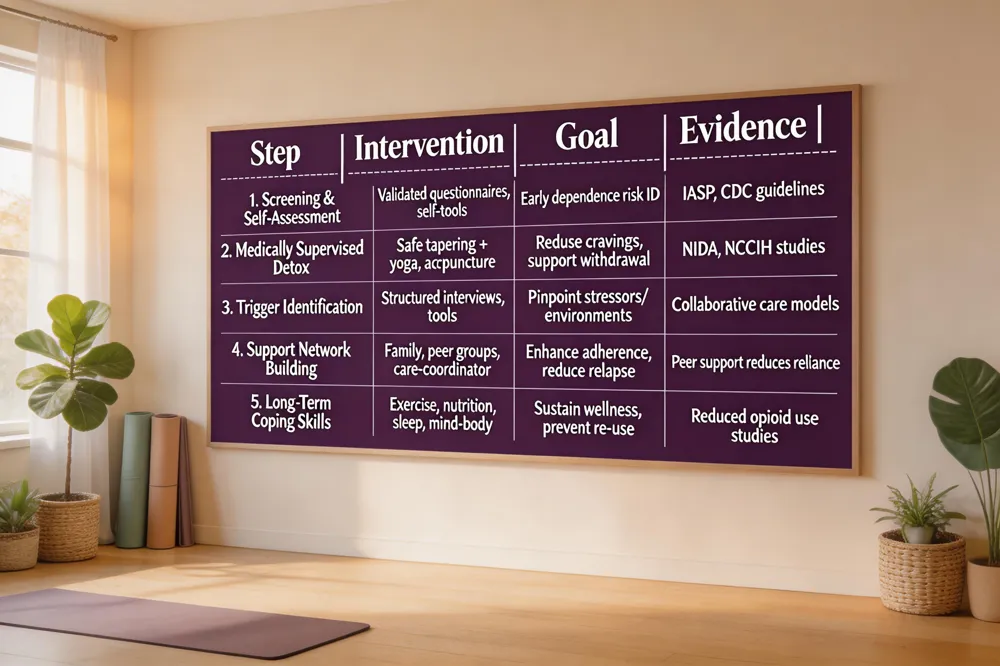 We start with honest self‑assessment tools and professional screening to help you recognize early signs of dependence, a step supported by the IASP definition of integrative care and CDC recommendations for non‑pharmacologic monitoring. If dependence is identified, we arrange medically supervised detox that combines safe medication tapering with evidence‑based therapies such as acupuncture, yoga, and mindfulness‑based stress reduction, which have been shown to lower opioid cravings and support withdrawal (NIDA, NCCIH). Next, we work together to pinpoint personal triggers—stress, certain environments, or social cues—using structured interviews and validated questionnaires. You will then develop a supportive network that includes family, peer groups, and a care‑coordinator, echoing findings that collaborative models improve satisfaction and reduce medication reliance. Finally, we equip you with long‑term coping skills: regular exercise, anti‑inflammatory nutrition, sleep hygiene, and mind‑body practices that sustain wellness and keep drug use from returning.
Regional Holistic Pain Resources: Colorado & Wyoming
| Location | Partner Facility | Services Offered | Contact |
|---|---|---|---|
| Loveland, CO | Sterling Regional MedCenter (Sterling) & Lincoln Community Hospital (Hugo) | Massage, acupuncture, spinal manipulation, yoga, mindfulness, regenerative injections | 970‑233‑5189 or 1‑866‑471‑5371 |
| Powell, WY | Powell Valley Healthcare (777 Ave H) | Radiofrequency ablation, nerve blocks, physical therapy, massage, lifestyle counseling | 307‑754‑7783 or 1‑800‑928‑6040 |
 Holistic Pain Management (HPM) brings evidence‑based integrative therapies—massage, acupuncture, spinal manipulation, yoga, mindfulness and regenerative injections to rural Colorado and Wyoming. In Loveland, CO, HPM does not have a dedicated clinic but partners with Sterling Regional MedCenter (Sterling) and Lincoln Community Hospital (Hugo) to deliver short‑wait, personalized pain‑relief plans. Residents call 970‑233‑5189 or 1‑866‑471‑5371 to be routed to the nearest partner site. In Powell, WY, HPM collaborates with Powell Valley Healthcare at 777 Avenue H, offering radiofrequency ablation, nerve blocks, physical therapy, massage and lifestyle counseling during extended weekday hours (7 AM‑7 PM). Appointments are booked by calling 307‑754‑7783 or the nurse line 1‑800‑928‑6040. Both locations emphasize a biopsychosocial model, combining conventional medicine with mind‑body techniques to lower opioid use and improve function. Community access is enhanced through coordinated referrals, tele‑health options and a patient‑centered care team that tailors treatment to each individual’s needs and long‑term health.
Integrated Pain Care and Complementary Medicine
| Modality | Target Pain Pathway | Evidence of Effectiveness | Typical Session |
|---|---|---|---|
| Acupuncture | Neuro‑inflammatory & peripheral pain | 30‑40 % reduction in low‑back/neck pain, lower opioid use | 6‑12 sessions, 45‑60 min |
| Massage & Spinal Manipulation | Mechanical tension & joint dysfunction | Short‑term functional gains, pain relief | 1‑2 times/week, 30‑45 min |
| Yoga / Tai Chi | Cognitive‑affective & musculoskeletal | Improved range of motion, mood, QoL; benefits up to 1 yr | 2‑3 times/week, 60 min |
| Anti‑Inflammatory Nutrition (Omega‑3, Vitamin D, Turmeric) | Systemic inflammation | Modulates inflammatory cytokines, supports tissue repair | Ongoing dietary changes |
| Mind‑Body (Mindfulness, Guided Imagery, VR) | Central pain processing | Reduces catastrophizing, lowers pain intensity | 10‑20 min daily or weekly group |
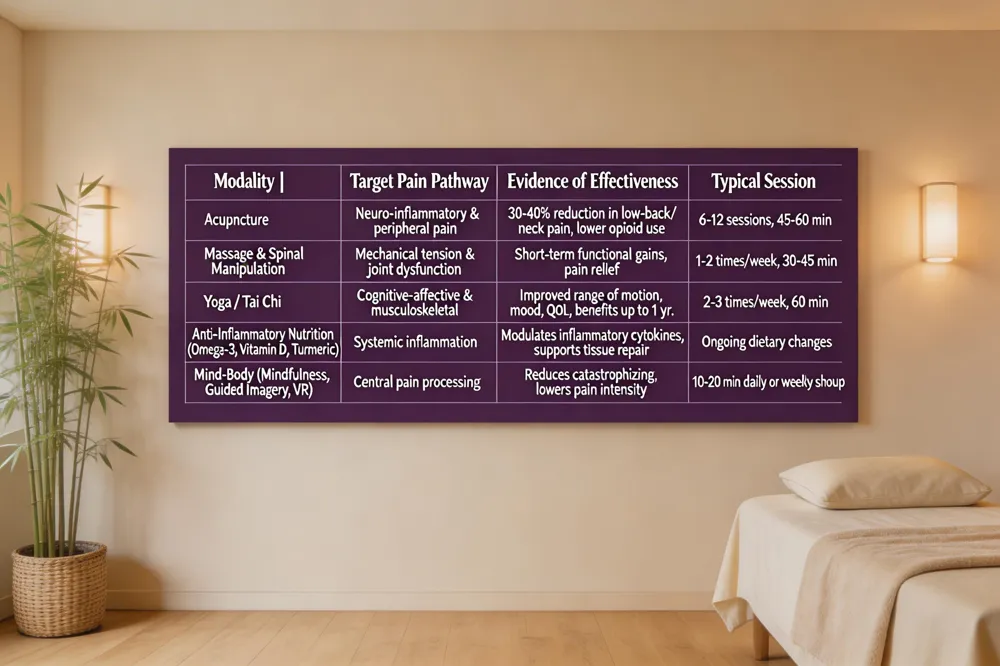 Integrated pain care blends conventional medicine with complementary therapies to treat chronic pain as a biopsychosocial condition. A multimodal framework coordinates physicians, physical therapists, acupuncturists, yoga instructors, and mental‑health specialists so that each modality targets a different pain pathway—mechanical, neuro‑inflammatory, and cognitive‑affective. Robust evidence shows acupuncture reduces low‑back and neck pain scores by 30‑40% and can lower opioid requirements, while systematic reviews confirm short‑term functional gains and pain relief from massage and spinal manipulation. Yoga and tai chi improve range of motion, mood, and quality of life, with benefits persisting for at least one year in randomized trials. Anti‑inflammatory dietary strategies—omega‑3 fatty acids, antioxidants, vitamin D, and turmeric modulate systemic inflammation and support tissue repair, further decreasing medication reliance. Patient‑centered planning tailors these interventions to individual preferences, comorbidities, and social determinants, fostering active participation, education, and sustained functional improvement.
Integrated pain care: Integrated pain care blends conventional medicine with complementary therapies to address both the physical and emotional aspects of pain. By coordinating physicians, physical therapists, acupuncturists, and mental‑health specialists, a personalized plan can include medication management, targeted injections, regenerative treatments such as PRP, and non‑invasive modalities like acupuncture and infrared light. This multidisciplinary model encourages active patient participation, offering education, functional restoration exercises, and coping strategies that improve mobility and reduce reliance on opioids. Clinics that practice integrated pain care also focus on safety and quality, adhering to rigorous infection‑control protocols and leveraging Medicare‑approved billing to keep out‑of‑pocket costs low. The result is a holistic, patient‑centered approach that aims to restore function, alleviate discomfort, and enhance overall wellbeing.
Management of chronic pain using complementary and integrative medicine: Complementary and integrative medicine (CIM) offers a multimodal strategy that addresses the physical, emotional, and behavioral dimensions of chronic pain while minimizing the adverse effects of conventional analgesics. Evidence supports the use of acupuncture, spinal manipulation, and massage for low‑back, neck, and arthritic pain, and mind‑body practices such as mindfulness‑based stress reduction, yoga, tai chi, and qigong have been shown to reduce pain intensity and improve mood and function. Anti‑inflammatory dietary strategies—omega‑3 fatty acids, antioxidants, vitamin D, and turmeric can modulate pain pathways and complement other therapies. Herbal medicines and nutraceuticals, when selected and monitored carefully, provide additional analgesic and anti‑inflammatory benefits without the addiction risk of opioids. By integrating these safe, patient‑centered approaches with conventional care, clinicians can create personalized pain‑management plans that enhance quality of life and reduce reliance on pharmacologic treatments.
Evidence‑Based Alternative Therapies and Herbal Options
| Therapy / Herb | Indication | Mechanism | Cautions |
|---|---|---|---|
| Acupuncture | Chronic low‑back, osteoarthritis, headache | Stimulation of endogenous opioids, neuromodulation | Minor bruising, rare infection |
| Yoga / Tai Chi | Musculoskeletal pain, functional decline | Gentle movement, breath‑body | coordination |
| Therapeutic Massage | Myofascial pain, tension | Mechanical pressure, increased circulation | Contraindicated with certain skin conditions, anticoagulants |
| Turmeric (curcumin) | Inflammatory pain | NF‑κB inhibition, antioxidant | Interacts with anticoagulants, may affect drug metabolism |
| Ginger | Joint pain, nausea | Anti‑inflammatory, COX inhibition | May increase bleeding risk with warfarin |
| Willow Bark | Mild to moderate pain | Salicin → analgesic effect | Avoid in aspirin allergy, GI ulcer risk |
| Lavender (essential oil) | Anxiety‑related pain | Calming CNS effects | Skin irritation, avoid ingestion |
| TENS | Neuropathic or musculoskeletal pain | Gate‑control theory, electrical nerve stimulation | Not for patients with pacemakers |
| Topical Capsaicin | Neuropathic pain | Desensitizes nociceptors | Burning sensation, avoid broken skin |
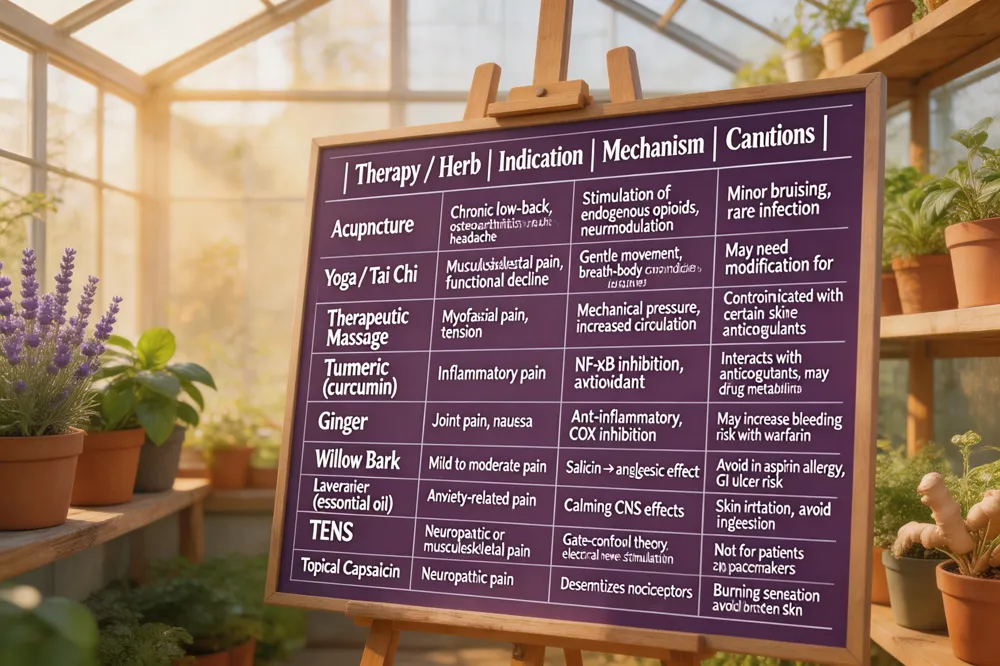 Research supports a suite of evidence‑based alternative pain‑management strategies. Acupuncture consistently lowers pain intensity for chronic low‑back, osteoarthritis and headache pain, while yoga, tai‑chi and therapeutic massage improve functional outcomes and reduce reliance on opioids (CDC, NCCIH). Cognitive‑behavioral and mindfulness‑based interventions further diminish pain severity and catastrophizing.
Herbal medicines such as turmeric, ginger, willow bark and lavender have anti‑inflammatory properties that can modestly reduce musculoskeletal discomfort; however, they may interact with anticoagulants or opioids, so clinician oversight is essential.
For neuropathic pain, non‑pharmacologic options include topical capsaicin or lidocaine, TENS, acupuncture, graded exercise, and heat/cold therapy. Mind‑body tools—especially guided imagery—help patients shift attention away from painful stimuli, lowering stress‑driven amplification of nerve pain.
Future directions point toward multimodal, mechanism‑guided protocols that blend these modalities with personalized nutrition, sleep hygiene and digital health platforms to sustain opioid‑free relief.
Moving Forward with Integrative Pain Solutions
Integrative pain care blends evidence‑based therapies such as massage, acupuncture, spinal manipulation, yoga, and mindfulness with conventional medical treatment, delivering clinically meaningful pain relief, functional gains, and fewer adverse effects than long‑term opioid or NSAID use. By educating patients on the neurobiology of pain and offering a menu of personalized options, these programs empower individuals to become active participants in their healing journey. If you are ready to explore this approach, start by discussing integrative options with your primary provider, request a referral to a certified pain‑management clinic, and consider joining a group‑visit program that combines education, movement, and nutrition counseling. Helpful resources include the American Pain Society guidelines, the CDC’s non‑pharmacologic recommendations, and local integrative centers such as the People’s Community Clinic (555‑123‑4567) or the Chicago Pain and Wellness Institute (708‑244‑7246).