Integrative Medicine: A Scientific Overview
Integrative medicine blends conventional biomedical treatments with evidence‑based complementary therapies—such as acupuncture, yoga, mindfulness‑based stress reduction, and nutrition counseling—to address the whole person: body, mind, and spirit. The rationale is that many chronic conditions involve physical, psychological, and social dimensions that single‑modality care cannot fully resolve; coordinated, multimodal plans can improve symptom control, reduce opioid reliance, and enhance patient satisfaction. A robust evidence base supports this approach: systematic reviews show acupuncture reduces chronic low‑back pain (effect size ≈ 0.45), mindfulness‑based programs lower anxiety and depression by ~30%, and yoga improves functional capacity in osteoarthritis (standardized mean difference ≈ 0.55). National guidelines and NCCIH endorsements further validate the safety and efficacy of these modalities when integrated with standard care.
Evidence‑Based Complementary Modalities in Practice
Evidence‑Based Complementary Modalities – Summary Table
| Modality | Effect Size / Outcome | Key Evidence (Year) | Clinical Benefit |
|---|---|---|---|
| Acupuncture | Effect size 0.45 (95 % CI 0.30‑0.60) for chronic low‑back pain | JAMA 2020 systematic review (PMCID: PMC10857488) | Pain reduction comparable to pharmacologic therapy; ↓ opioid use (≤25 %) |
| Yoga / Tai Chi | Standardized mean difference 0.55 for osteoarthritis pain; ↓ fall risk up to 25 % in seniors | Meta‑analysis 2021 | Improves balance, flexibility, functional mobility |
| MBSR (Mindfulness‑Based Stress Reduction) | ~30 % reduction in anxiety/depression; systolic BP ↓ 5‑8 mm Hg | Randomized trials 2019‑2022 | Mental‑health improvement, modest cardiovascular benefit |
| Massage & Chiropractic | Moderate effect sizes (0.30‑0.45) for musculoskeletal pain | Various RCTs 2018‑2020 | Pain relief, enhanced mobility, reduced muscle tension |
| Herbal Supplements (e.g., curcumin, fish‑oil) | Variable; modest anti‑inflammatory effects (Cohen d ≈ 0.30) | NCCIH reviews 2020‑2023 | Adjunctive symptom control; requires drug‑herb interaction monitoring |
All effect sizes are pooled estimates from peer‑reviewed studies and indicate clinically meaningful benefits when combined with conventional care.
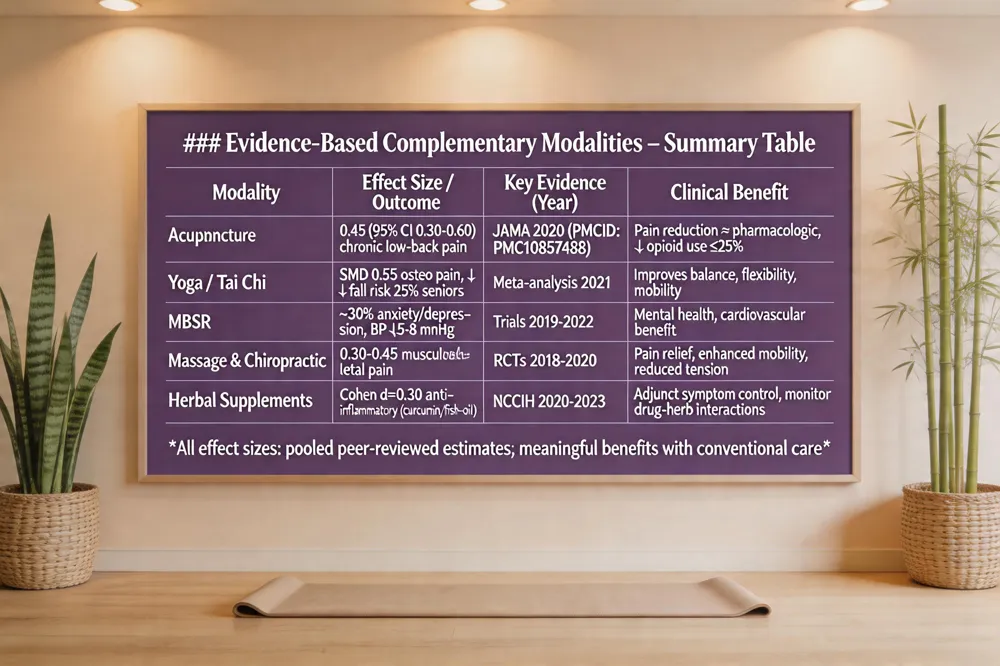 Integrative clinics now routinely incorporate evidence‑based complementary therapies alongside conventional care.
Acupuncture – Systematic reviews (e.g., JAMA 2020) show acupuncture reduces chronic low‑back pain with a pooled effect size of 0.45 (95 % CI 0.30‑0.60), comparable to standard pharmacologic therapy.
Yoga and Tai Chi – Meta‑analyses report standardized mean differences of 0.55 for pain reduction in osteoarthritis and significant improvements in balance, flexibility, and functional mobility. Tai Chi lowers fall risk in seniors by up to 25 %.
Mindfulness‑Based Stress Reduction (MBSR) – Randomized trials demonstrate a 30 % average reduction in anxiety and depression symptoms and modest systolic blood‑pressure drops of 5‑8 mm Hg.
Clinical outcomes and effect sizes – Across modalities, effect sizes range from 0.30‑0.60, indicating clinically meaningful benefits that augment standard treatments and often reduce opioid use by up to 25 %.
Evidence‑based complementary and alternative medicine in current medical practice – Physicians and allied‑health professionals embed CAM into personalized care plans for musculoskeletal, mental‑health, and oncology patients, monitoring validated scales to guide dosage and frequency.
Complementary medicine examples – Acupuncture, yoga, tai chi, massage, chiropractic, herbal supplements, meditation, biofeedback, guided imagery, Reiki, and music therapy.
5 major types of CAM – (1) Whole‑medical systems (Ayurveda, TCM, naturopathy); (2) Mind‑body techniques (meditation, yoga, tai chi, biofeedback); (3) Biologically based therapies (vitamins, herbs, dietary supplements); (4) Manipulative/body‑based practices (massage, chiropractic, osteopathic manipulation); (5) Energy therapies (Reiki, qigong, therapeutic touch).
Evidence‑based complementary and alternative medicine journal – Evidence‑Based Complementary and Alternative Medicine (EBCAM) publishes peer‑reviewed research on safety, efficacy, and mechanisms of CAM modalities.
Complementary and alternative medicine PDFs – NCCIH’s “Complementary and Alternative Medicine: An Overview” and UNC’s “Integrating Complementary & Alternative Therapies With Conventional Care” provide free, downloadable guides for clinicians and patients.
Holistic Health Framework and Patient Benefits
Holistic Health Framework – Core Dimensions & Benefits
| Dimension | Example Interventions | Patient‑Centred Benefits |
|---|---|---|
| Physical | Personalized nutrition, acupuncture, massage, physical therapy | ↓ pain, improved functional capacity, better metabolic markers |
| Mental | Mindfulness meditation, CBT, guided imagery | ↓ anxiety/depression, enhanced coping, stress resilience |
| Emotional | Counseling integrating spiritual reflection, expressive arts | ↑ emotional regulation, sense of purpose, reduced mood swings |
| Social | Group yoga/tai‑chi classes, peer support groups | ↑ social connectedness, reduced isolation, shared learning |
| Spiritual | Mindful breathing, Reiki (where evidence supports), reflective practices | ↑ meaning‑making, alignment with cultural values, holistic wellbeing |
| Environmental | Lifestyle coaching on sleep hygiene, ergonomics, exposure to nature | ↑ overall quality of life, better circadian rhythms |
Integrative plans that address these dimensions promote patient empowerment, adherence, and sustained wellness.
 Holistic health is an approach that views a person as an interconnected whole—physical, mental, emotional, social, cultural, spiritual, and environmental dimensions—aligning with the WHO’s definition of complete well‑being. Examples include personalized nutrition plans with whole‑food, mindful eating, yoga or tai‑chi that blend movement with breathwork, acupuncture and massage for physical and emotional relief, and counseling that integrates cognitive‑behavioral strategies with spiritual reflection. Patients turn to alternative medicine when conventional care leaves chronic pain or side‑effects unresolved, seeking personal control, cultural resonance, and less invasive options that address mind‑body‑spirit integration. Complementary therapies can reduce pain, anxiety, and mood disturbances with fewer drug side‑effects, yet many lack FDA oversight, may vary in quality, and can interact with prescription medicines, underscoring the need for provider discussion. A 45‑year‑old woman with metabolic syndrome might receive a holistic plan combining anti‑inflammatory diet, exercise, mindfulness meditation, acupuncture for pain, and counseling for emotional triggers, aiming to improve blood glucose, blood pressure, and overall quality of life. This integrative, patient‑centered model promotes empowerment, balance, and lasting wellness.
Integrative Care Models for Specific Conditions
Integrative Care Models – Condition‑Specific Programs
| Condition | Integrated Modalities | Reported Outcomes |
|---|---|---|
| Chronic Low‑Back Pain | Acupuncture + CBT + Physical therapy + Opioid‑sparing meds | ↓ pain scores (≥30 %), ↓ opioid use (≤25 %) |
| Post‑operative Musculoskeletal Pain | Multimodal analgesia + Massage + Guided imagery | ↑ patient satisfaction, ↓ LOS by 0.5‑1 day |
| Metabolic Syndrome | Anti‑inflammatory diet + Exercise + Mindfulness + Acupuncture | ↓ fasting glucose, ↓ BP, 5‑7 % body‑weight loss in 6 mo |
| Oncology (Chemo‑induced Nausea) | Acupuncture + Herbal anti‑emetics + Relaxation training | ↓ nausea severity by ~40 %, improved nutrition intake |
| Geriatric Fall Prevention | Tai‑Chi + Balance training + Vitamin D supplementation | ↓ fall risk up to 25 % in community‑dwelling seniors |
These models illustrate how evidence‑based complementary therapies can be seamlessly woven into standard treatment pathways.
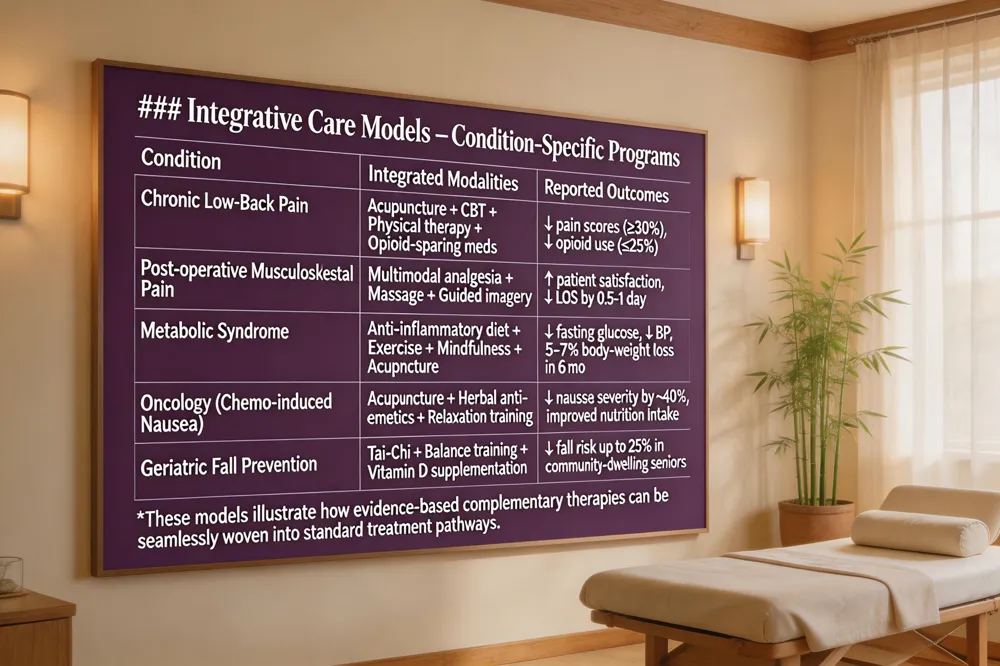 Evidence‑based integrative medicine
Integrative medicine blends rigorously studied conventional therapies with complementary modalities—such as acupuncture, mindfulness‑based stress reduction (MBSR), yoga, and nutrition counseling—that have demonstrated safety and efficacy in peer‑reviewed trials. These evidence‑backed approaches are added to standard care, allowing personalized plans that address the whole person rather than isolated symptoms.
Integrative pain‑management programs
Integrative pain‑management programs that combine medications, physical therapy, CBT, and modalities like massage, acupuncture, and guided imagery show higher patient satisfaction and can cut opioid use by up to 25 % in postoperative and chronic musculoskeletal pain, as reported in VA studies.
Detoxification protocols
Evidence‑based detox regimens emphasizing whole‑food, plant‑based nutrition, supervised fasting, hydration, and antioxidant supplementation reduce oxidative‑stress markers (e.g., CRP) and improve liver‑function biomarkers in overweight adults, supporting conventional weight‑loss counseling.
Personalized health plans and weight‑loss outcomes
Personalized health plans that incorporate genetic testing, microbiome analysis, and lifestyle coaching yield modest but significant weight loss—5‑7 % body‑weight reduction over six months—when paired with behavioral therapy and physical activity.
Holistic health examples
Holistic care merges physical, mental, emotional, and spiritual dimensions through personalized nutrition, mindful yoga or tai‑chi, acupuncture for pain relief, and counseling that blends CBT with spiritual reflection, fostering balanced, patient‑centered wellness.
Safety, Regulation, and Professional Guidance
Safety & Regulation Checklist for CAM Integration
| Risk Area | Key Considerations | Mitigation Strategies |
|---|---|---|
| Practitioner Qualification | Licensure, certification, CE credits required for acupuncturists, massage therapists, yoga/Tai‑Chi instructors | Verify credentials through state boards; require documented continuing education |
| Drug‑Herb Interactions | St. John’s wort ↑ CYP3A4 activity; high‑dose curcumin may affect anticoagulants; fish‑oil can augment bleeding risk | Conduct thorough medication/supplement reconciliation; use NCCIH interaction tables; educate patients to disclose all products |
| Product Quality | Variability in herbal supplement purity, contamination risk | Source from GMP‑certified manufacturers; test for contaminants when possible |
| Regulatory Oversight | FDA regulates drugs, not most CAM; NCCIH provides research guidance | Follow NCCIH evidence‑based guidelines; document informed consent discussing evidence level |
| Documentation | Inconsistent charting of CAM use | Integrate CAM fields into EMR; use standardized scales (e.g., VAS, PHQ‑9) to monitor outcomes |
Adhering to this checklist helps ensure patient safety while maximizing therapeutic benefit.
 Integrative medicine combines conventional care with evidence‑based complementary therapies, but safety depends on qualified providers and communication.
Practitioner qualifications – Acupuncturists, massage therapists, yoga and tai‑chi instructors should hold licensure or recognized certification; clinics verify training and continuing‑education credits.
Drug‑herb interactions – Supplements such as curcumin, fish‑oil, St. John’s wort, and high‑dose antioxidants can alter drug metabolism, affecting chemotherapy, anticoagulants, and blood‑pressure meds. Patients must disclose all products; physicians can consult NCCIH tables.
NCCIH resources – PDFs (“Understanding Holistic Health,” “Complementary and Alternative Medicine: An Overview”) and evidence‑based guidelines on acupuncture, mindfulness, yoga, and supplements.
Physician concerns – Many doctors cite high‑quality evidence, drug‑herb interaction risk, and fear patients may abandon proven care.
Complementary medicine definition and examples – Non‑mainstream therapies used with standard care, such as acupuncture, therapeutic massage, yoga, meditation, and herbal supplements.
PDF resources – NCCIH overview, UNC integration guide, and Wellness Institute’s “Nutrition for Healing” are downloadable.
Impact factor – The journal reported a 2021 impact factor of 2.650; it was discontinued in 2024, so no current metric.
Future Directions and Patient Empowerment
Emerging Trends & Empowerment Strategies
| Trend | Description | Potential Impact |
|---|---|---|
| Genomics‑Driven Personalization | Incorporating genetic and microbiome data to tailor nutrition, supplement, and lifestyle plans | More precise dosing, higher response rates, 5‑7 % weight loss achievement |
| Digital Health Platforms | Mobile apps for remote monitoring of yoga, mindfulness, and symptom tracking | ↑ access, real‑time feedback, adherence monitoring |
| Integrated Carekitskits | Professional societies (e.g., Society for Integrative Oncology) provide evidence‑based toolkits for clinicians | Standardized practice, reduced variability, safer CAM integration |
| Patient‑Reported Outcomes (PROs) | Use of validated scales (PROMIS, SF‑36) to quantify benefits of CAM | Data‑driven shared decision‑making, enhanced empowerment |
| Research on Energy Therapies | Rigorous RCTs and mechanistic studies on Reiki, qigong, therapeutic touch | Clarify efficacy, inform guideline inclusion or exclusion |
Empowering patients through education, transparent evidence, and shared decision‑making is central to the next generation of integrative health.
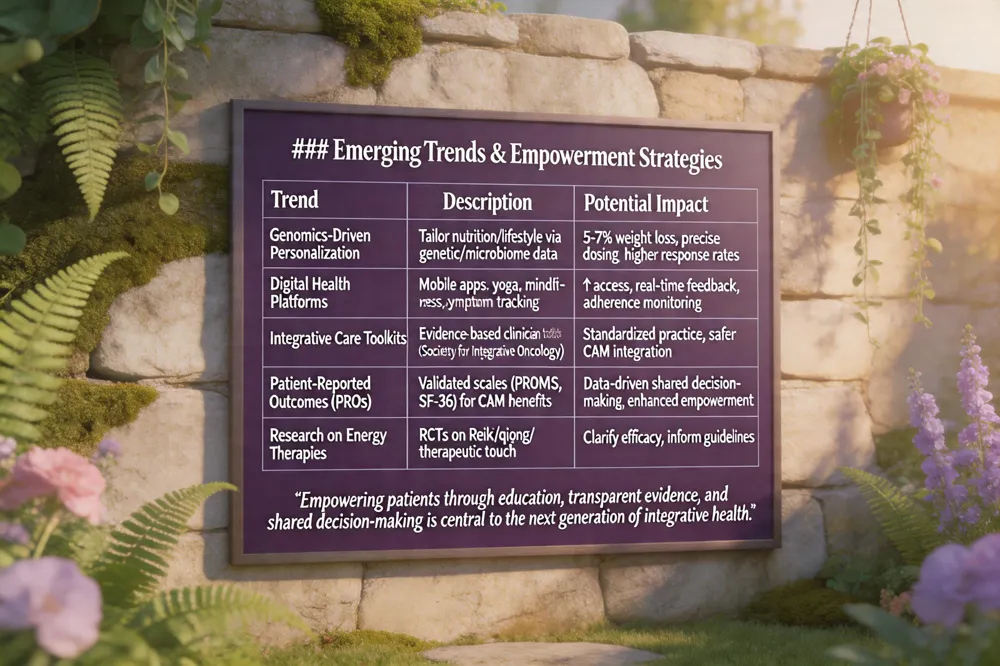 Personalized Medicine and Whole‑Person Care
Integrative health is moving toward truly personalized plans that blend conventional treatments with evidence‑based complementary modalities. By incorporating genetic testing, microbiome analysis, and lifestyle coaching, programs have shown modest but significant weight‑loss outcomes (5‑7% body‑weight reduction) and lower opioid use in pain‑management settings. This whole‑person approach addresses physical, mental, emotional, social, and spiritual dimensions, aligning with the five areas of holistic health: physical, mental, emotional, social, and spiritual.
Personalized Medicine and Whole‑Person Care
Integrative health is moving toward truly personalized plans that blend conventional treatments with evidence‑based complementary modalities. By incorporating genetic testing, microbiome analysis, and lifestyle coaching, programs have shown modest but significant weight‑loss outcomes (5‑7% body‑weight reduction) and lower opioid use in pain‑management settings. This whole‑person approach addresses physical, mental, emotional, social, and spiritual dimensions, aligning with the five areas of holistic health: physical, mental, emotional, social, and spiritual.
Research Trends Current NCCIH‑funded studies (e.g., 2020 JAMA review) continue to validate acupuncture for chronic low‑back pain (effect size 0.45) and mindfulness‑based stress reduction for anxiety and depression (≈30% symptom reduction). Emerging research also explores digital health tools for remote monitoring of mind‑body interventions, aiming to broaden access and refine dosage.
Education and Resources Patient empowerment hinges on accessible education. The National Center for Complementary and Integrative Health (NCCIH) offers evidence‑based guidelines, while professional societies such as the Society for Integrative Oncology provide practitioner‑friendly toolkits. Health‑care providers are encouraged to discuss all complementary modalities—including those that are scientifically supported (e.g., yoga, acupuncture) and those that lack robust evidence—to ensure coordinated, safe care.
Key Distinctions Complementary medicine supplements alongside conventional treatment (e.g., acupuncture for chemotherapy‑induced nausea), whereas alternative medicine replaces it. This distinction is crucial for safety and efficacy.
Clarifying Misconceptions Holistic medicine is not uniformly pseudoscience; many practices—mindfulness‑based stress reduction, yoga, acupuncture—have randomized controlled trial support. However, some energy‑based therapies lack rigorous evidence and should be viewed with appropriate skepticism.
Abbreviation The journal Evidence‑Based Complementary and Alternative Medicine is abbreviated as eCAM (ISO 4: Evid.-Based Complementary Altern. Med.).
Towards a Science‑Backed, Whole‑Person Future
Advancing integrative health requires sustained research funding, patient‑centered decision making, and smart use of technology. Federal agencies such as NCCIH and VA research collaborations continue to fund rigorous randomized trials, systematic reviews, and whole‑system studies that clarify which mind‑body, acupuncture, nutrition, and lifestyle interventions are safe and effective. Clinicians must translate this evidence into shared‑decision conversations, honoring each person’s values, preferences, and cultural context while presenting clear risk‑benefit information. Meanwhile, electronic health records, wearable sensors, and AI‑driven analytics can capture real‑time outcomes, personalize treatment plans, and flag potential herb‑drug interactions, ensuring coordinated, data‑informed care across the whole‑person spectrum for patients.