The Entrepreneurial Stress Crisis
Entrepreneurs are wrestling with a perfect storm of time pressure and mental‑health strain. The U.S. Small Business Administration reports that 73 % of small‑business owners log more than 50 hours a week, a workload that fuels chronic stress. The National Institute of Mental Health shows anxiety disorders affect 48 % of U.S. adults, with entrepreneurs experiencing even higher rates due to relentless business demands. A 2022 Gallup poll reveals that 57 % of workers would be more productive with better work‑life balance, underscoring a growing appetite for services that simplify personal tasks. Reflecting this demand, the U.S. concierge‑service market expanded to an estimated $7.5 billion in 2023, signaling that high‑earning professionals are turning to personalized lifestyle management to reclaim health, focus, and productivity.
Understanding Integrative Wellness
Seven Pillars of Holistic Health
| Pillar | Core Focus | Typical Practices |
|---|---|---|
| Movement & Fitness | Physical vitality | Exercise routines, yoga, strength training, walking |
| Healthful Nutrition | Nutrient intake | Whole‑food diet, meal planning, supplementation |
| Restorative Sleep | Recovery & cognition | Sleep hygiene, bedtime routines, relaxation techniques |
| Stress Management | Emotional resilience | Meditation, breathwork, mindfulness, biofeedback |
| Social Engagement | Community & support | Group activities, networking, family time |
| Gratitude & Reflection | Mental well‑being | Journaling, gratitude lists, reflective meditation |
| Cognitive Enhancement | Mental acuity | Brain‑training apps, reading, continued education |
 Integrative wellness is a whole‑person approach that blends conventional medicine with evidence‑based complementary practices to address every facet of an individual’s life. It considers physical, mental, emotional, and social dimensions—including diet, movement, stress management, and relationships—to promote optimal healing and prevention. Central to this model is a collaborative patient‑practitioner relationship, where treatment plans are personalized to each person’s unique goals and needs. Practitioners may combine nutrition counseling, yoga, acupuncture, meditation, and health coaching, aiming to prevent, treat, and even reverse chronic diseases while honoring the interconnected nature of body, mind, and spirit.
The seven pillars of holistic health form the foundation of this approach: (1) movement & fitness, (2) healthful nutrition, (3) restorative sleep, (4) stress management, (5) social engagement, (6) gratitude & reflection, and (7) cognitive enhancement. Together, they support physical vitality, mental resilience, emotional balance, and mental acuity, creating a comprehensive framework for sustainable, personalized well‑being.
The Role of a Wellness Concierge
Core Services & Direct Benefits
| Service | What It Entails | Direct Benefit to Entrepreneur |
|---|---|---|
| 24/7 Physician Access | On‑call doctor via phone/app | Immediate medical advice, reduced downtime |
| Same‑Day/Next‑Day Appointments | Rapid scheduling of visits | Minimizes missed work hours |
| Integrated Health Records | Centralized EMR shared with providers | Holistic view, avoids duplicate tests |
| Proactive Wellness Plans | Customized diet, fitness, mindfulness plans | Prevents chronic issues, boosts performance |
| Personal Concierge Tasks | Grocery, dry‑cleaning, travel booking | Frees mental bandwidth, lowers stress |
| Digital Lifestyle Management | Apps for class bookings, tele‑health, reminders | Streamlines routine, improves adherence |
 A wellness concierge acts as a personal health advocate, turning a fragmented healthcare system into a seamless, holistic experience tailored to the busy entrepreneur. By consolidating medical records and coordinating with physicians, specialists, and insurers, the concierge ensures every provider sees the full picture of a client’s health. This advocacy includes 24/7 physician access and instant appointment scheduling—often same‑day or next‑day visits—so entrepreneurs can address health concerns without sacrificing work time.
Beyond reactive care, the concierge develops proactive wellness plans that blend conventional preventive services with integrative therapies such as nutrition counseling, yoga, acupuncture, and mindfulness coaching. Regular check‑ins and personalized coaching keep clients accountable to fitness, stress‑management, and longevity goals.
Personal concierge services also handle routine chores—grocery shopping, dry cleaning, appointment booking—freeing mental bandwidth and reducing stress. Leveraging mobile apps and virtual assistants, these services streamline fitness class bookings, nutrition counseling, and spa appointments, allowing entrepreneurs to invest more time in personal development, hobbies, and relationships. In this way, a wellness concierge not only supports health but directly enhances work‑life balance.
Financial Landscape of Concierge Medicine
Key Financial Aspects
| Aspect | Details | Typical Range / Notes |
|---|---|---|
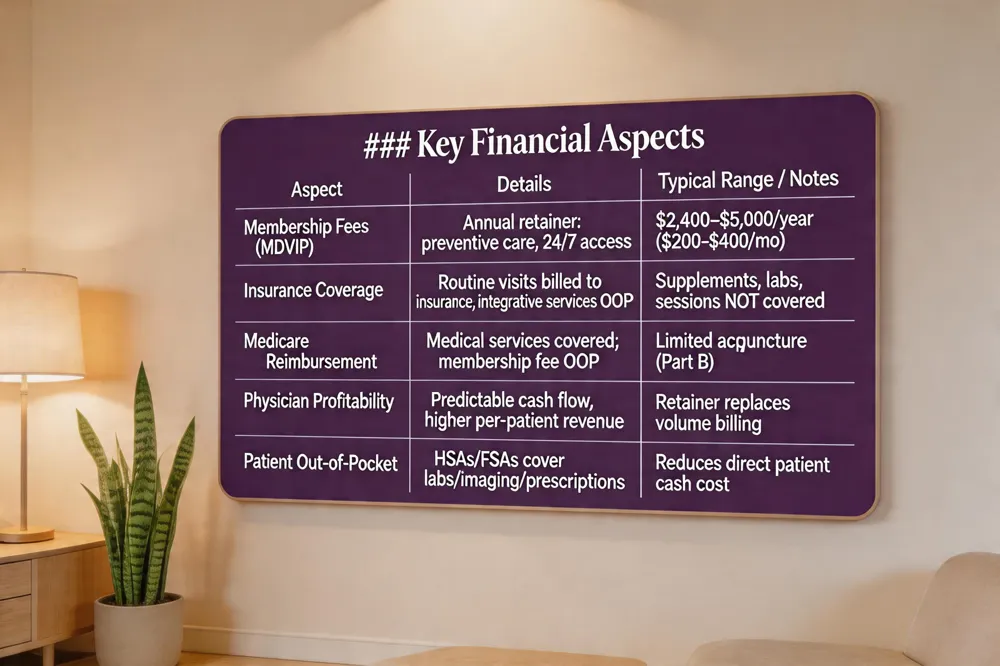
| Membership Fees (MDVIP) | Annual retainer covering preventive care, diagnostics, 24/7 access | $2,400 – $5,000 per year (≈$200‑$400/mo) |
| Insurance Coverage | Routine visits billed to insurance; most integrative services out‑of‑pocket | Supplements, functional labs, extended sessions not covered |
| Medicare Reimbursement | Covers medical services if billed; membership fee always out‑of‑pocket | Limited acupuncture sessions under Part B |
| Physician Profitability | Predictable cash flow, higher per‑patient revenue, lower admin costs | Retainer model replaces volume‑based billing |
| Patient Out‑of‑Pocket | HSAs/FSAs can cover labs, imaging, prescriptions ordered by concierge | Reduces direct cash cost for patients |
 Membership fees and MDVIP pricing
MDVIP’s annual fee usually ranges from $2,400 to $5,000 (≈$200‑$400/month). It covers a preventive program, advanced diagnostics, and same‑day appointments; routine visits are billed to insurance, which does not reimburse the fee.
Profitability for physicians
The retainer model gives predictable cash flow. By limiting panels and charging a few thousand dollars per patient, doctors replace volume with higher per‑patient earnings, cut billing overhead, and charge rates for 24/7 access and house calls, making the practice attractive. Physicians also benefit from staffing costs because fewer appointments mean less administrative work.
Does insurance cover holistic health?
Coverage varies. Some private plans reimburse acupuncture or naturopathic visits where allowed, but most supplements, functional‑medicine labs, and extended wellness sessions are out‑of‑pocket via HSAs/FSAs. Medicare and Medicaid offer little reimbursement.
Does insurance cover integrative medicine?
Many insurers now cover acupuncture, chiropractic, and, in some states, naturopathic care, often requiring a referral and limiting visits. Medicare Part B pays for a few acupuncture sessions for chronic back pain, but most integrative services remain uncovered.
Will Medicare pay for a concierge doctor?
Medicare can reimburse the medical services a concierge practice provides if it bills Medicare, but the membership fee is always an out‑of‑pocket charge and is not covered. Members can use their HSA/FSA for labs, imaging, and prescriptions that the concierge practice orders.
Holistic Health Careers and Earnings
Earnings by Role (Annual)
| Role | Salary Range (USD) |
|---|---|
| Alternative Medicine Practitioner | $250,000 – $287,500 |
| Reiki Healer | $110,000 – $130,000 |
| Licensed Acupuncturist | $82,500 – $99,000 |
| Naturopathic Physician | $80,000 – $107,500 |
| Conventional Optometrist | $140,000 – $141,000 |
| Medical Dosimetrist | $140,000 – $141,000 |
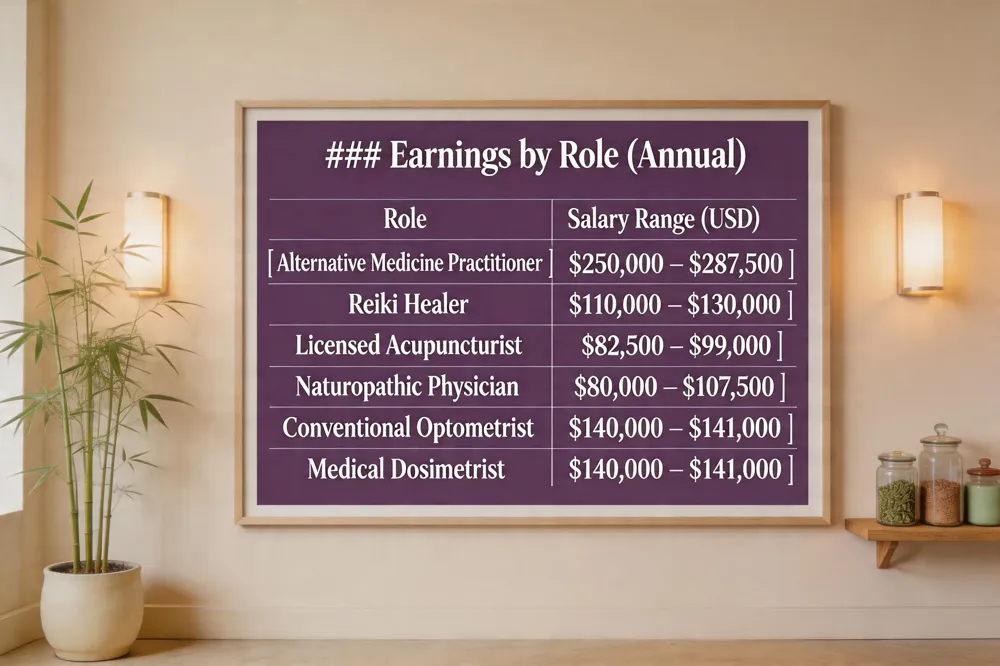 The integrative‑health market is booming, and the financial upside reflects that growth. What holistic job makes the most money? Within the field, the highest‑earning role is an Alternative Medicine Practitioner, with annual earnings ranging from $250,000 to $287,500. Other lucrative specialties include Reiki Healers ($110,000‑$130,000), Licensed Acupuncturists ($82,500‑$99,000) and Naturopathic Physicians ($80,000‑$107,500). These figures surpass many conventional health salaries, such as optometrists or medical dosimetrists, which hover around $140,000‑$141,000. Reaching the top tier typically requires advanced certification, a strong niche brand, and a loyal client base.
What is the easiest medical business to start? Entrepreneurs can launch low‑overhead ventures like health coaching, medical billing and coding services, caregiver or senior‑companion agencies, telehealth consulting, or a niche health‑education blog/YouTube channel. These ideas leverage existing expertise, need minimal capital, and can be scaled quickly using digital platforms.
Career pathways for entrepreneurs Start by identifying a personal wellness passion, obtain the necessary credentials, then build a concierge‑style practice that blends conventional medicine with holistic services—mind‑body coaching, nutrition, yoga, or acupuncture. Leveraging technology (telehealth, app‑based scheduling) and a personal concierge model helps attract high‑earning clients while preserving work‑life balance.
Integrating Concierge Care into Entrepreneurial Life
Entrepreneurial Self‑Care Routine & Time Savings
| Routine Element | Description | Approx. Time Saved per Week |
|---|---|---|
| Clear Work Boundaries | Set end‑of‑day cut‑off, no emails after hours | 3 hrs |
| Mindful Breaks (Pomodoro) | 5‑min breathing every 25 min | 2 hrs |
| Daily Movement (15‑min walk/yoga) | Physical reset, improves focus | 1.5 hrs |
| Concierge‑Handled Chores | Grocery, dry‑cleaning, appointment booking | 2.7 hrs |
| Integrated Wellness Coaching | Weekly check‑ins, goal tracking | 1 hr |
| Nutritional Planning | Personalized meal plans, prep guidance | 1 hr |
| Overall | 11.2 hrs saved, allowing focus on growth & personal development |
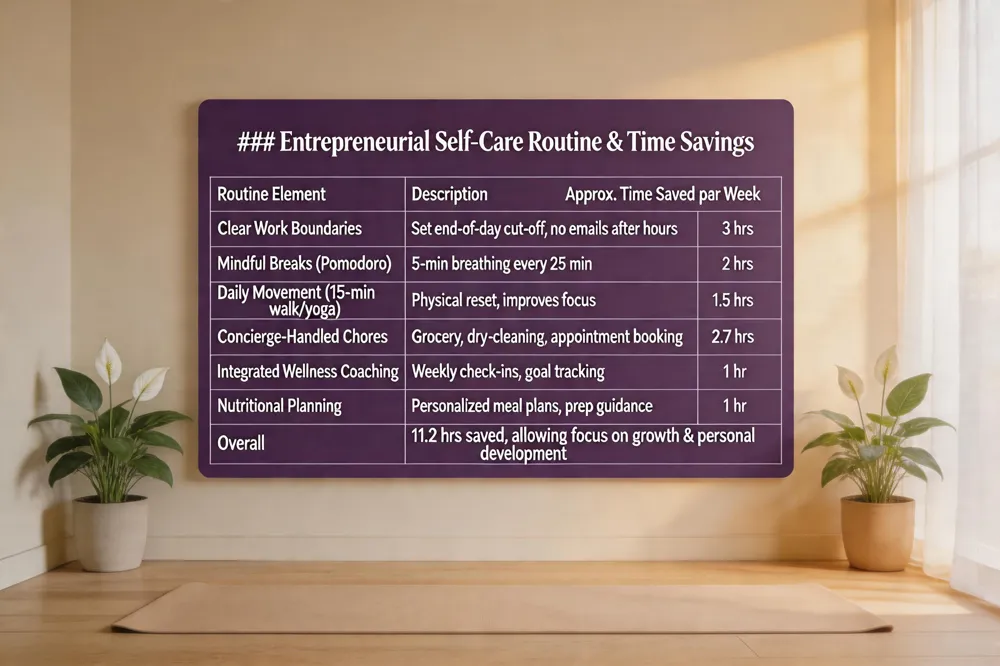 Entrepreneurs often juggle 50‑plus hour weeks, which drives chronic stress, anxiety, and burnout (U.S. Small Business Administration; CDC). A practical self‑care routine—clear work boundaries, mindful breaks, and daily movement—provides the backbone for health, while integrative tools such as yoga, acupuncture, and nutrition counseling (American Psychological Association; Mayo Clinic) boost resilience. Time‑management techniques like the Pomodoro method, realistic goal‑setting, and delegating routine chores to a personal concierge free mental bandwidth; concierge services handle grocery shopping, dry cleaning, and appointment scheduling, cutting average request time by 2.7 hours (Circles) and reducing mental overload (How Concierge Services Enhance Work‑Life Balance).
Two main types of concierge practices exist. Retainer‑based concierge medicine offers extended visits, 24/7 physician access, and may still bill insurance, whereas direct primary care (DPC) operates on a flat monthly fee without insurance, delivering same‑day appointments and personalized wellness plans (Discover Health; Brightmark Health).
For small business teams, concierge medicine translates into lower absenteeism, higher productivity, and predictable health spending, as illustrated by Brightmark Health’s model that integrates preventive care, lifestyle medicine, and holistic support (Brightmark Health).
A Balanced Future for Entrepreneurs
Recent data show that 73 % of small‑business owners work over 50 hours weekly and nearly half of U.S. adults face anxiety disorders, underscoring the chronic stress burden on entrepreneurs. Concierge and lifestyle‑management services have proven to cut mental overload, improve work‑life balance, and boost productivity—evidence reflected in the $7.5 billion concierge market and Gallup’s finding that 57 % of workers crave better balance. Entrepreneurs should seize this momentum by adding a lifestyle concierge that handles errands, schedules wellness appointments, and coordinates integrative therapies such as yoga, nutrition counseling, and mindfulness. Doing so aligns perfectly with Eclipse Wellness’s mission to blend conventional medicine with evidence‑based holistic care, delivering personalized, whole‑person support that fuels sustainable success.