Why Personalized Care Matters Today
Personalized care flips the health system from reacting to disease after it appears to preventing it before it takes hold. By weaving together genetic information, everyday lifestyle choices, and social determinants such as housing, food security, and transportation, clinicians can pinpoint each person’s unique risk profile and design interventions that fit real‑life circumstances. This precision approach mirrors the growing demand of American patients—over 70 % now expect care that reflects their individual values, preferences, and health goals. When providers listen, co‑create plans, and use tools like wearable data and risk‑assessment dashboards, patients feel heard, stay engaged, and are more likely to follow preventive and therapeutic recommendations, ultimately improving outcomes and reducing costly complications for a healthier future and sustainable health systems.
Understanding Personalized Healthcare and Its Impact
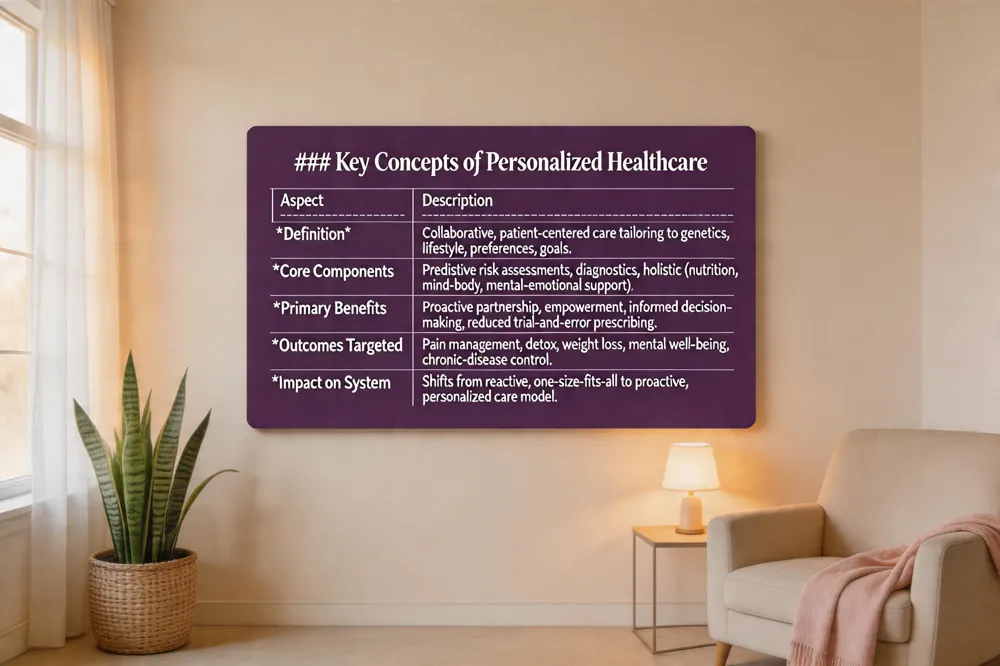
Key Concepts of Personalized Healthcare
| Aspect | Description |
|---|---|
| Definition | Collaborative, patient‑centered approach tailoring care to genetics, lifestyle, preferences, and goals. |
| Core Components | Predictive risk assessments, conventional diagnostics, holistic modalities (nutrition, mind‑body, mental‑emotional support). |
| Primary Benefits | Proactive partnership, empowerment, informed decision‑making, reduced trial‑and‑error prescribing. |
| Outcomes Targeted | Pain management, detox, weight loss, mental well‑being, chronic‑disease control. |
| Impact on System | Shifts from reactive, one‑size‑fits‑all to proactive, personalized care model. |
 What does personalized care mean?
Personalized care is a collaborative, patient‑centered approach that tailors health and wellness plans to each individual’s genetics, lifestyle, preferences, and goals. By integrating predictive risk assessments, conventional diagnostics, and holistic modalities (nutrition, mind‑body practices, mental‑emotional support), providers co‑create measurable plans that address pain management, detox, weight loss, and mental well‑being. This shifts care from a reactive, one‑size‑fits‑all model to a proactive partnership that empowers patients to make informed decisions.
What does personalized care mean?
Personalized care is a collaborative, patient‑centered approach that tailors health and wellness plans to each individual’s genetics, lifestyle, preferences, and goals. By integrating predictive risk assessments, conventional diagnostics, and holistic modalities (nutrition, mind‑body practices, mental‑emotional support), providers co‑create measurable plans that address pain management, detox, weight loss, and mental well‑being. This shifts care from a reactive, one‑size‑fits‑all model to a proactive partnership that empowers patients to make informed decisions.
Why is personalized healthcare important? Tailoring treatment to unique risk factors improves effectiveness and reduces trial‑and‑error prescribing, lowering side‑effects and costly interventions. Engagement rises when patients see their values reflected in care, leading to higher medication adherence, fewer hospital readmissions, and better chronic‑disease outcomes. Addressing social determinants of health—transportation, food security, housing—within plans further promotes equity and access.
What does personalized healthcare mean? It is a proactive system that uses genetic, familial, and environmental data to predict disease risk and guide preventive actions such as diet, exercise, and stress‑reduction. Clinicians and patients set shared goals, monitor progress with customized metrics, and adjust interventions in real time through digital tools, telehealth, and wearable data.
What is personalized medicine? Personalized medicine applies genomic and molecular insights to customize prevention, diagnosis, and treatment. By matching therapies to a patient’s molecular profile, it enhances efficacy, minimizes adverse reactions, and supports early detection, blending cutting‑edge science with holistic care.
What are the benefits of a personalised care plan? A personalized plan reduces redundant testing, cuts healthcare costs, and improves clinical outcomes. It boosts patient empowerment, satisfaction, and self‑efficacy, while fostering stronger therapeutic alliances and better coordination of physical, emotional, and social health dimensions.
Patient Empowerment Through Personalized Plans
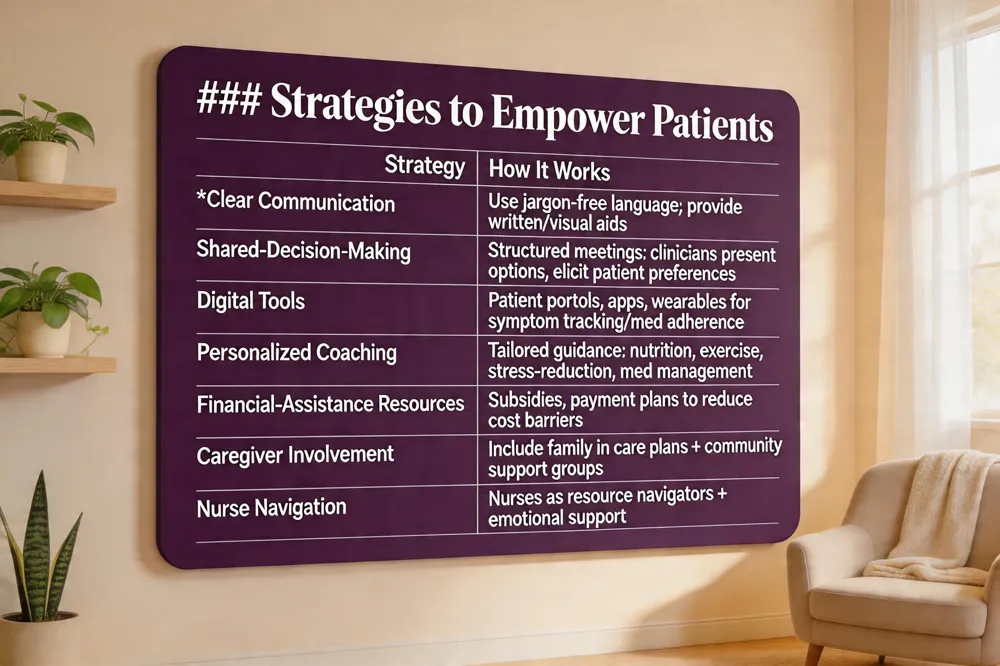
Strategies to Empower Patients
| Strategy | How It Works |
|---|---|
| Clear Communication | Use jargon‑free language; provide written and visual aids. |
| Shared‑Decision‑Making | Structured meetings where clinicians present options and elicit patient preferences. |
| Digital Tools | Patient portals, mobile apps, wearables for symptom tracking and medication adherence. |
| Personalized Coaching | Tailored guidance on nutrition, exercise, stress‑reduction, medication management. |
| Financial‑Assistance Resources | Tools to reduce cost barriers (e.g., subsidies, payment plans). |
| Caregiver Involvement | Include family members in care‑plan updates and community support groups. |
| Nurse Navigation | Nurses act as resource navigators and emotional support providers. |
 Patient empowerment in personalized health care means giving people the knowledge, tools, and confidence to steer their own wellness journey. Reliable educational resources, patient portals, and mobile apps let individuals monitor symptoms, medication adherence, and lifestyle habits, turning data into actionable insights. When clinicians present balanced information about all treatment options and actively invite patients to voice preferences, shared‑decision‑making transforms a passive visit into a collaborative partnership—patients feel heard, respected, and in control of their care plan.
Strategies that empower patients and families include clear, jargon‑free communication; structured shared‑decision‑making meetings; personalized coaching on nutrition, exercise, stress‑reduction, and medication management; and access to financial‑assistance tools that reduce cost barriers. Caregiver involvement in care‑plan updates, quality‑improvement committees, and community support groups further strengthens the safety team.
Nurses play a pivotal role by delivering tailored education, acting as navigators to resources such as tele‑health appointments and transportation services, and providing compassionate emotional support. Their advocacy ensures that social determinants of health—food security, housing, and transportation—are addressed within the care plan.
When empowerment aligns with patient‑centred, self‑management approaches, adherence improves, hospital readmissions decline, and overall health outcomes—such as lower HbA1c, reduced blood pressure, and better mental‑health scores—are enhanced. Empowered patients experience a stronger sense of agency, leading to sustained, holistic well‑being.
Integrative Functional Medicine and Holistic Care
Core Elements of Integrative Functional Medicine
| Element | Example |
|---|---|
| Whole‑Person Focus | Mind, body, spirit assessment and treatment. |
| Evidence‑Based Conventional Care | Prescription meds, physical therapy, standard diagnostics. |
| Complementary Therapies | Acupuncture, yoga, meditation, mindfulness‑based stress reduction, massage. |
| Personalized Care Plans | Combine meds, lifestyle changes, supplements, detox protocols. |
| Care Coordination | Specialist referrals, safety monitoring, outcome tracking. |
| Legitimacy Sources | Mayo Clinic, Cleveland Clinic endorsement of integrative approaches. |
| Common Practices | Acupuncture for pain, tai chi for flexibility, nutrition counseling with herbal supplements. |
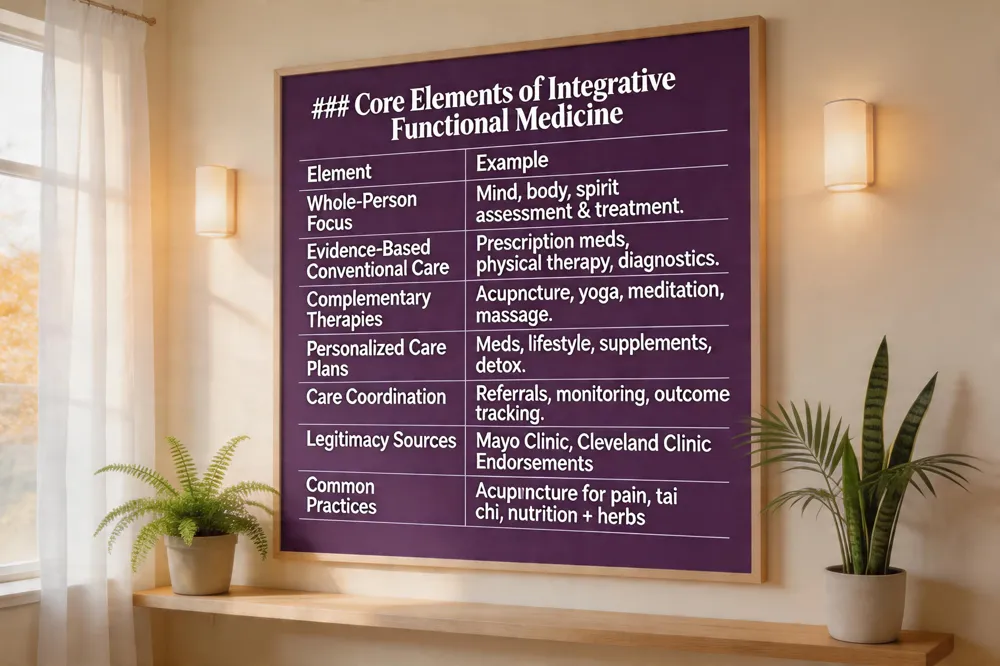 An integrative medicine doctor treats the whole person—mind, body, and spirit—by combining evidence‑based conventional treatments with complementary therapies like acupuncture, yoga, or meditation. The physician gathers a detailed lifestyle history, identifies causes of pain, mental‑health issues, metabolic imbalance, or weight gain, and then designs a personalized care plan that may include medication, physical therapy, mindfulness‑based stress reduction, detox protocols, and targeted supplements. The doctor coordinates care across specialists, monitoring safety and effectiveness.
Holistic integrative medicine is an evidence‑based whole‑person model that blends conventional care with proven complementary therapies (e.g., acupuncture, yoga, nutrition counseling, mind‑body practices) to address physical, emotional, mental, and spiritual needs. It fosters a collaborative partnership where lifestyle changes and personalized plans are central to healing.
Yes, integrative medicine is legitimate when it combines well‑researched conventional treatments with evidence‑based complementary therapies. Leading institutions such as the Mayo Clinic and Cleveland Clinic endorse it as a safe, effective, whole‑person approach when delivered by qualified professionals and coordinated with primary care.
Common integrative practices include acupuncture for pain relief, yoga or tai chi for flexibility and stress reduction, mindfulness for mental health, massage therapy for relaxation, dietary counseling paired with herbal or nutritional supplements, and animal‑assisted therapy to enhance emotional well‑being.
Personalized Care Coordination and Tools
Features of an Individualized Care Plan (ICP)
| Feature | Description |
|---|---|
| Goal‑Setting | Specific health‑related goals (e.g., pain ≤3/10, 5‑lb weight loss). |
| Assessment Basis | Medical history, functional abilities, lifestyle preferences, social determinants. |
| Intervention Mix | Medications, integrative therapies, nutrition protocols, supplements. |
| Monitoring Metrics | Weekly pain/anxiety ratings, bi‑weekly weigh‑ins, functional mobility tests. |
| Adjustment Frequency | Reviewed at least annually or when conditions change; often every 2‑4 weeks. |
| Epic Integration | SmartSets, order‑sets, outcome dashboards, patient portal co‑management. |
| Insurance Alignment | Coverage tailored to patient needs, reducing unnecessary services and costs. |
| Industry Examples | Medtronic (adaptive neurostimulators), Roche (genomic platforms), OK Capsule (custom supplements). |
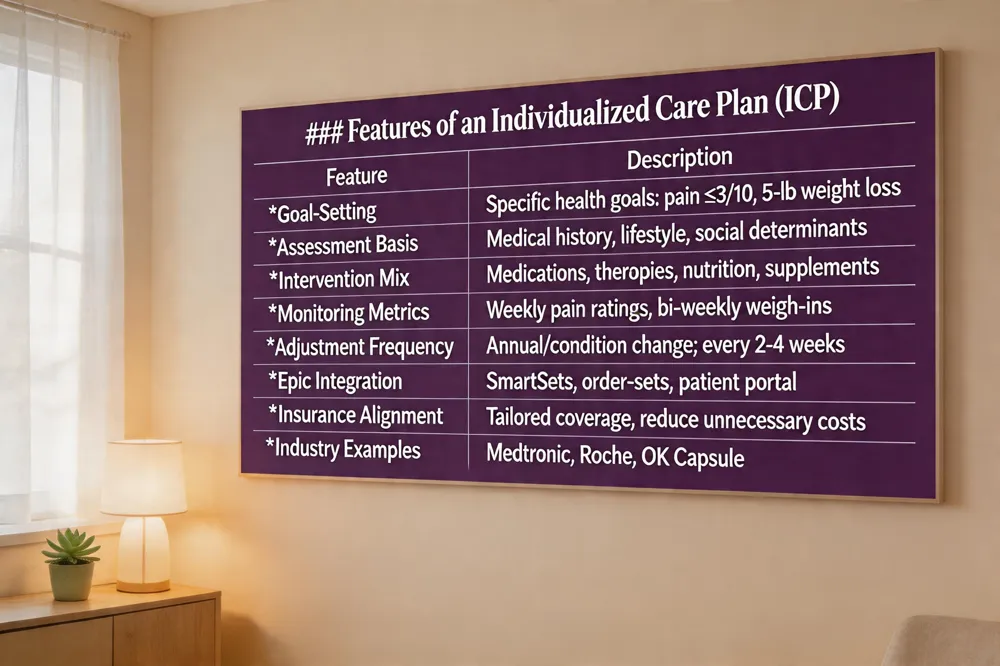 What is an individualized plan of care? An individualized plan of care (ICP) is a personalized roadmap that outlines a person’s specific health‑related goals, preferred treatments, and needed services. It is built after a comprehensive assessment of medical history, functional abilities, lifestyle preferences, and social needs, coordinating providers, medications, therapies, and supports. The ICP is reviewed regularly—at least annually or when conditions change—to keep care current and effective, promoting higher quality of life and patient satisfaction.
Example of an individualized care plan A 42‑year‑old woman with chronic low‑back pain, anxiety, and a goal to lose 15 lb receives a plan that includes weekly integrative physical‑therapy, mindfulness‑based stress reduction, an anti‑inflammatory nutrition protocol, and magnesium/omega‑3 supplementation. Short‑term goals target pain reduction to ≤3/10, a 30 % drop in GAD‑7 scores, and a 5‑lb loss in the first month. Progress is tracked via weekly pain and anxiety ratings, bi‑weekly weigh‑ins, and functional mobility assessments, with the plan adjusted every two weeks.
How to individualize a patient’s care plan in Epic Clinicians start with a detailed assessment, then select a personalized care‑plan template. Epic’s SmartSets and order‑sets embed patient‑specific diagnoses, interventions (e.g., tailored pain‑management, mental‑health resources, detox protocols), and education materials. Outcome dashboards and progress notes track effectiveness, while the patient portal lets patients view, comment on, and co‑manage their plan.
Why personalized insurance plans benefit clients Tailored coverage aligns premiums with actual health needs, eliminating unnecessary services and reducing out‑of‑pocket costs. When plans explicitly cover integrative therapies—such as pain‑management, mental‑health counseling, detox, or weight‑loss programs—patients experience fewer financial barriers, higher adherence, and greater peace of mind.
Companies providing personalized healthcare services Medtronic delivers patient‑centered technologies like adaptive neurostimulators and smart insulin pens. Roche offers a data‑driven personalized‑healthcare platform for genomic‑guided therapies. OK Capsule creates customized daily supplement packets based on individual nutritional profiles. Emerging health‑tech startups add hyper‑personalized remote monitoring, AI diagnostics, and bespoke pain‑management solutions, expanding the ecosystem of personalized care.
Real‑World Outcomes and Evidence
Evidence‑Based Outcomes of Personalized Care
| Metric | Reported Impact |
|---|---|
| Diabetes Prevention | Lifestyle interventions lower type 2 diabetes risk by up to 50 % in prediabetic patients. |
| Hypertension | Personalized management reduces systolic BP by average 2.64 mm Hg. |
| HbA1c Reduction | Integrated chronic‑care programs achieve mean ↓0.24 % HbA1c. |
| Readmission Reduction | Hospital readmissions ↓ up to 30 % with personalized plans. |
| Cost Savings | Average $1,200 per patient per year saved by eliminating redundant tests. |
| Patient Satisfaction | 70 % report improved care; 88 % say communication preferences boost satisfaction. |
| Adherence | Customized recommendations increase likelihood of medication adherence by 1.5×. |
| Pain Management | Integrative approaches improve chronic‑pain outcomes by 20‑25 % and reduce opioid use. |
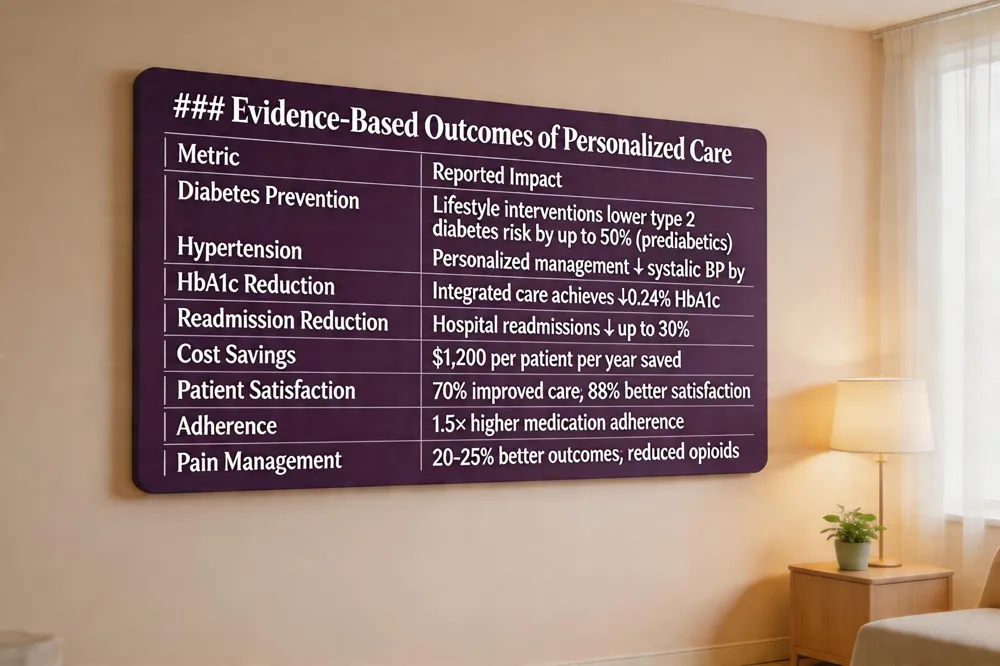 Personalized care plans are proving their value across multiple dimensions. Clinical improvements are evident: Studies show that lifestyle interventions (e.g., diet, exercise, smoking cessation) can lower the risk of developing type 2 diabetes by up to 50% in prediabetic patients, while Personalized hypertension management can lower systolic blood pressure by an average of 2.64 mm Hg. Integrated chronic‑care programs that use monthly touch‑points report mean HbA1c reductions of 0.24 % and enhanced medication adherence.
Cost reductions follow these health gains. By eliminating redundant tests and focusing resources on high‑impact, individualized interventions, healthcare systems have lowered overall utilization, saved an average of $1,200 per patient per year, and Personalized care plans reduce hospital readmissions by up to 30%. Practices that embed personalized workflows see higher quality‑metric scores and increased revenue.
Patient satisfaction and adherence statistics are compelling. According to the article, 70% of individuals with long‑term conditions experience improved care due to personalized planning, and 88% of consumers say communication preferences boost satisfaction. Patients who receive customized recommendations are 1.5 times more likely to follow medication regimens and attend follow‑up appointments.
Research on integrative and personalized approaches reinforces these findings. Combining conventional medicine with evidence‑based complementary therapies—such as acupuncture, mindfulness, and nutrition counseling—improves chronic‑pain outcomes by 20‑25% and reduces opioid reliance. Shared decision‑making models that co‑create care plans empower patients, fostering confidence, self‑efficacy, and a stronger therapeutic alliance.
Future Directions and Takeaways
Integrative personalized services are poised to expand as more clinics blend conventional care with evidence‑based complementary therapies—acupuncture, yoga, nutrition counseling—tailored to each patient’s genetics, lifestyle, and social determinants of health. Digital tools such as AI‑driven risk analytics, wearable sensors, and patient‑portal dashboards will scale empowerment, delivering real‑time insights that guide shared decision‑making and reduce redundant testing. To realize these gains, patients should actively engage in health‑risk assessments, set realistic goals with coaches, and use technology to track progress, while providers must embed shared‑goal setting into every visit, integrate SDOH data, and adopt interoperable platforms that support continuous, personalized care. Together, this partnership will drive earlier prevention, lower costs, and higher satisfaction across the health system.